










New Delhi Bureau
Summary: Delhi’s air turned severe again on the morning of 4 November. At 7 am the city’s average Air Quality Index stood at 373, in the very poor category, while Punjabi Bagh recorded 452 and many areas crossed 400. Meanwhile, the Gurugram administration has decided to ban construction and demolition work from 5 to 20 November and move half of government and private office staff to work from home. The second stage of the Graded Response Action Plan is in force across Delhi-NCR, and the Commission for Air Quality Management has also ordered a ban on certain construction and demolition activities for the same 15-day period.
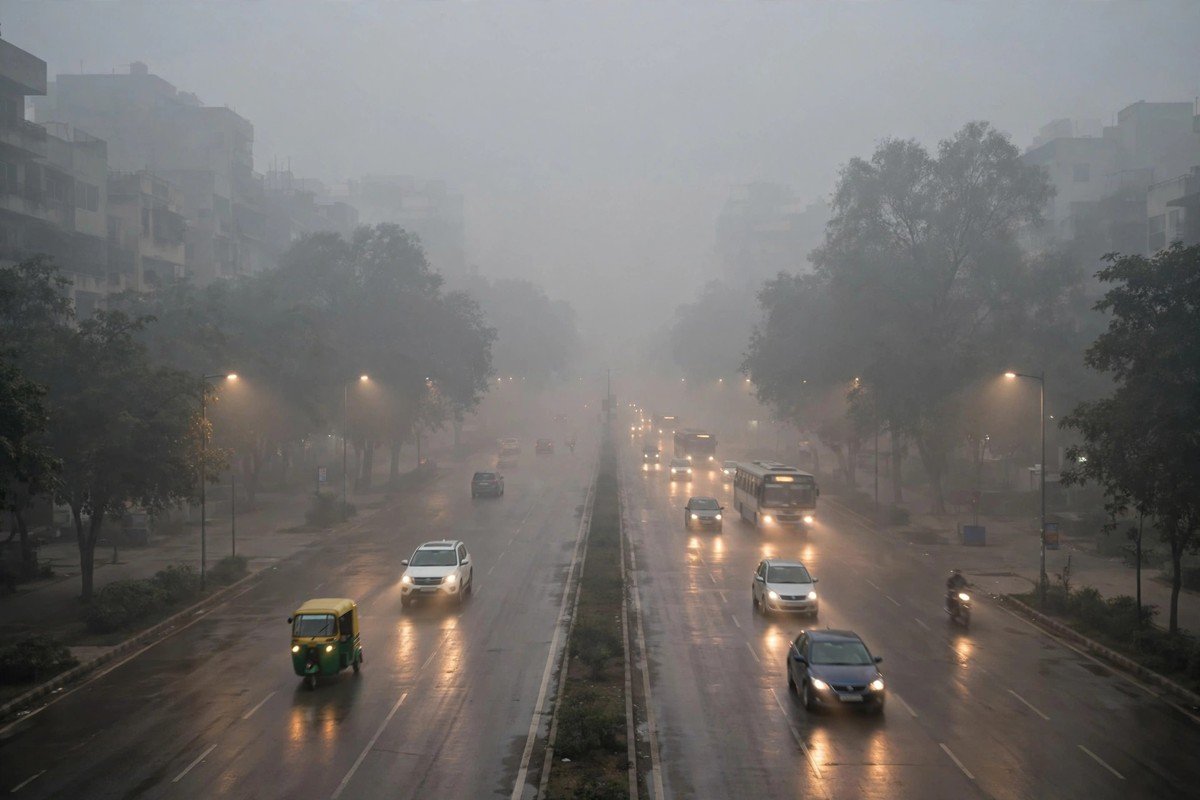
As November begins, Delhi’s air quality tends to worsen. Slow winds and morning haze trap pollutants close to the ground, making breathing difficult in the early hours and increasing complaints of eye irritation and throat discomfort. The readings on the morning of 4 November show that the problem is not confined to one locality. Monitoring stations across the north, west, central and southern parts of the city recorded high values, placing large parts of the capital between the very poor and severe categories.
Morning snapshot at 7 am: average 373, Punjabi Bagh at 452
At 7 am, Delhi’s average Air Quality Index was 373. On this scale, readings between 201 and 300 fall in the poor category, 301 to 400 in the very poor category, and above 400 in the severe category. The city average was therefore very poor, but several localities had already entered the severe range. Punjabi Bagh was the most polluted area, with a reading of 452. Jahangirpuri followed at 450, and the Indian Institute of Technology Delhi area recorded 446. Mundka stood at 440, Rohini at 435, and the Delhi Technological University area at 434. The Indian Institute of Tropical Meteorology centre at Pusa recorded 429, RK Puram 423, and Alipur 421. ITO and Narela both recorded 418, Patparganj 415, Mandir Marg and North Campus 413 each, the Karni Singh Shooting Range and Okhla Phase-2 411 each, Bawana 410, and the Jawaharlal Nehru Stadium area 406. All of these localities were in the severe category.
It is important to understand that air quality readings change with time and station. The 7 am snapshot is one part of the day’s picture, not the whole picture. Wind speed, sunshine and temperature during the day can push readings up or down. No single locality or single hour should therefore be treated as the permanent figure for the whole day. Even so, the morning figures clearly signal that large parts of Delhi began 4 November at levels that raise health concerns.
Below 400, still no relief: many areas in the very poor range
Areas that stayed below 400 offered little comfort. The Major Dhyan Chand National Stadium and Dwarka Sector-8 both recorded 398. The Central Road Research Institute station on Mathura Road and the Delhi Pollution Control Committee centre at Pusa both recorded 392, Jawaharlal Nehru University 391, and Burari Crossing 390. The Commonwealth Sports Complex recorded 384, the National Institute of Health centre at Narela 382, and Netaji Subhas University of Technology at Jaffarpur 381. Aya Nagar recorded 379, Najafgarh 376, Chandni Chowk 369, and Nangloi 360. Indira Gandhi International Airport Terminal-3 recorded 358 and Burari 355. Shadipur recorded 348, Ashok Vihar 346, Netaji Subhas Institute of Technology at Dwarka 341, Ghoga 335, and Nehru Nagar 334. Badarpur recorded 330, Jharoda Kalan 321, and Maidan Garhi 314. All of these fall in the very poor category.
A few areas fared relatively better, but none could be described as clean. Anand Vihar recorded 300, the Cantonment area 299, Chhawla 296, the India Meteorological Department centre on Lodhi Road 294, and the Indira Gandhi National Open University station at Maidan Garhi 257. In other words, no major part of the city was in a category that could be called fully safe. That is why health experts have advised caution for all groups of people.

GRAP Stage-II in force: what restrictions apply
The second stage of the Graded Response Action Plan is in force as Delhi’s air continues to deteriorate. Under this stage, several restrictions apply to control pollution. Construction activities face curbs, and open burning of waste or other material, along with activities that spread smoke, is prohibited. Water is being sprinkled on roads through tankers to settle dust. To cut vehicular pollution, petrol pumps are not supplying petrol or diesel to vehicles without a valid Pollution Under Control Certificate. Entry of vehicles below Bharat Stage-VI norms into Delhi is also restricted. Vehicles are being checked at the Delhi-Noida border, and those violating the rules face fines or are sent back.
One nuance deserves attention. Stage-II does not amount to a complete ban on every kind of construction work, though most construction activity faces curbs. Separately, Delhi’s winter action plan bans dust-generating demolition and open civil construction work from 1 November 2026 to 31 January 2027. The Commission for Air Quality Management has also ordered a ban on certain construction and demolition activities across Delhi-NCR for 15 days, from 5 to 20 November. Together, these separate orders widen the scope of the construction and demolition curbs, but each order has its own scope and duration.
Gurugram’s 5 to 20 November curbs: construction ban, 50% work from home
In view of rising air pollution, the Gurugram district administration has decided on strict steps from 5 to 20 November. During this period, construction and demolition work will remain banned in Gurugram. The ban will also apply to projects such as roads, highways, flyovers and pipelines. Some essential infrastructure projects will be exempt, but they will have to follow the prescribed rules. The administration has also ordered daily inspections to monitor compliance. Violators will face action under Section 14 of the Commission for Air Quality Management Act, 2021, and other applicable provisions.
In addition, government and private offices have been given work-from-home arrangements. Only 50% of employees will attend office, while the remaining 50% will work from home. Offices will also have to maintain attendance records. Industrial units and essential services are exempt from this rule. The arrangement will remain effective from 5 to 20 November. The aim is to reduce the number of vehicles on the roads and to stop dust from construction sites, so that the load of pollutants in the air can come down to some extent.
Health precautions: what to do and what to avoid
Doctors have advised people to take precautions. They say morning walks should be avoided unless necessary, because pollution levels feel highest in the morning hours. Pregnant women, elderly people, children and those already suffering from illness need special care. Wearing an N95 mask outdoors is advisable. Keeping doors and windows shut when the haze outside is dense is also sensible. People with asthma, breathing problems or heart conditions should take their medicines on time and contact a doctor immediately if breathing difficulty increases. Children should be kept away from prolonged outdoor running and play for a few days.
This advice is not limited to a single day’s readings. In the early winter season, pollution levels in Delhi-NCR usually rise because cold air holds pollutants close to the ground. It is therefore important to keep watching air quality readings in the mornings and evenings in the coming days. Checking official monitoring data regularly can help people plan their day accordingly.
An earlier warning: the 2 November episode above 350
The deterioration on 4 November did not come out of nowhere. On 2 November, Delhi’s air had already turned toxic, with readings crossing 350 in several areas. Enforcement under the graded plan was intensified then, and the winter action plan was put in place for the season. The figures on 4 November show that the situation has not improved in two days; instead, several areas have crossed 400. That is why neighbouring districts such as Gurugram have now had to issue separate strict orders.
What next: new orders from 5 November, eyes on the readings
The most important date ahead is 5 November, when Gurugram’s construction ban and 50% work-from-home arrangement come into effect, along with the Commission’s 15-day order. How much difference these orders make will become clear only from the readings in the coming days. If wind speeds rise and weather conditions turn favourable, pollution levels may ease somewhat. If the air remains still and the haze stays dense, stricter measures may become necessary. For now, the administration’s focus is on monitoring station data, vehicle checks at borders, and inspections at construction sites. For ordinary residents, the safest course is to follow official readings, avoid unnecessary outings, and make masks and caution part of the daily routine.
Disclaimer: This news has been prepared on the basis of available sources and verification. In case of any factual error, a correction will be published.