






New Delhi Bureau
Summary: Exactly one week before Diwali, Delhi’s air has turned toxic once again. On Monday morning, the air quality index crossed 350 in several parts of the city, a level categorised as very poor. The average AQI jumped 144 points in just 24 hours, and the weather department has warned that conditions may worsen in the coming days.
Monday morning readings: how bad is the air, area by area
According to data from the Central Pollution Control Board, Delhi’s air was recorded in the very poor category across several areas on Monday morning. Around the Akshardham temple and ITO, the air quality index stood at 349. Around India Gate and Janpath, it was 335. Jahangirpuri recorded the worst pollution, with the AQI crossing 380. The city’s overall AQI was 310 at 8 am, while some pockets crossed even 400.
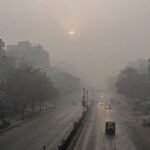
Of the board’s 59 monitoring stations, 43 recorded air in the poor to very poor categories. In 23 areas, the AQI crossed 300. At most stations, PM2.5 remained the dominant pollutant, considered the most harmful to health. The haze was so dense in the morning that visibility dropped below normal at many places, and vehicles had to drive with their headlights on.
A 144-point jump in 24 hours
The deterioration did not happen overnight, but its speed caught everyone by surprise. On Saturday, Delhi’s average AQI was 117, categorised as moderate. On Sunday, it rose to 261, a jump of 144 points in just 24 hours. By Sunday evening, conditions had worsened further. The AQI touched 272 at 6 pm, 287 at 10 pm and 290 at 11 pm.
Sunday thus ranked among the most polluted days of the season so far. Earlier, rain had brought some relief and the AQI had even dipped below 100, but once the rain stopped, pollutants began accumulating in the air again, and by Monday morning conditions had reached the very poor category.

Why the air worsened: stubble, winds and the end of rain
Several factors are working together behind Delhi’s worsening air. According to estimates from the decision support system for air quality management, the share of stubble burning stood at 18.57 percent on Sunday, against 5.33 percent on Saturday. In a single day, the contribution of stubble smoke more than tripled.
At the same time, north-westerly winds carried pollutants from Punjab and Haryana into Delhi. The weather department recorded a minimum temperature of 18 degrees Celsius in Delhi on Sunday, one degree below normal. In cold and calm air, pollutants stay trapped near the ground instead of dispersing, and the layer of haze grows denser. With the rain gone, this stagnation is now weighing heavily on Delhi’s air.
What lies ahead: worse by Wednesday, say forecasts
The central air quality early warning system offers little hope of immediate relief. Delhi’s air may stay in the poor category on Monday and Tuesday, and could reach the very poor level by Wednesday. The six-day outlook also points to air quality remaining between poor and very poor.
The weather department has likewise said conditions may deteriorate further in the coming days. This means Delhi’s residents may have to battle pollution through the entire week before Diwali, which is why the administration has stepped up both enforcement and monitoring.
GRAP and enforcement: winter plan in force since 1 November
A winter pollution control plan for Delhi came into force on 1 November, and the restrictions under the Graded Response Action Plan are being enforced strictly. Delhi’s environment minister Manjinder Singh Sirsa shared details on social media, stating that a major drive against polluting vehicles and construction sites was carried out on 1 November.
During that drive, 14,930 vehicles were checked on 1 November, 566 pollution-under-control challans were issued and 300 construction sites were inspected. Delhi Traffic Police has also increased surveillance at the borders to enforce the plan’s restrictions strictly. According to the traffic police, 7,279 vehicles were checked between midnight and 8 pm on 1 November. Awareness campaigns are being run through print media, social media, radio and large information boards at Delhi’s borders.
Health impact: who faces the highest risk, and how to stay safe
The Central Pollution Control Board divides air quality into six categories. From 0 to 50 is good, 51 to 100 satisfactory, 101 to 200 moderate, 201 to 300 poor, 301 to 400 very poor and 401 to 500 severe. On Monday morning, several Delhi areas were in the very poor category, considered worrying for health.
In very poor air, patients with respiratory illness, the elderly and children suffer the most. Eye irritation, throat discomfort, coughing and breathlessness tend to increase. Simple precautions help in such conditions: avoiding morning walks, wearing a mask outdoors, keeping doors and windows shut at home and drinking enough water. Anyone whose breathing difficulty increases should consult a doctor.
Rising worry before Diwali
Diwali falls on 8 November, and air quality worsening exactly a week before the festival has added to the worry. Past experience shows that fireworks during the festival push pollution levels even higher, so there is apprehension that levels may stay elevated around Diwali as well. Monitoring by the administration continues, and all eyes will be on the readings over the coming days.
Delhi’s bad air is not confined to the capital alone. Cities around the National Capital Region also feel the impact on air quality, which is why simultaneous monitoring and enforcement across the region is considered necessary. Residents are being urged to avoid activities that add to pollution and to follow the restrictions in force.
When Delhi’s air last turned this bad
This is not the first time this season that Delhi’s air has deteriorated sharply. On 23 October too, the city’s air had reached the severe category, when the AQI was recorded at 287 and the first stage of the Graded Response Action Plan was enforced. Rain after that brought some relief, but pollution picked up pace again at the start of November.
Experts believe that every year, as winter sets in, slow wind speeds, falling temperatures and stubble smoke combine to raise pollution levels in Delhi in late October and early November. The same cycle is visible this time as well. The only difference is the speed of the jump, which has put both the administration and ordinary residents on alert.
Disclaimer: This news has been prepared on the basis of available sources and verification. If there is any error in any fact, a correction will be published.