





New Delhi Bureau
Summary: The third Vande Bharat Sleeper service in the country has begun between Bengaluru and Mumbai. After the flag-off in Bengaluru on 1 November, regular service starts from Mumbai this evening, 2 November, while regular service from Bengaluru begins on 3 November. The train will run six days a week, travel overnight, and reach its destination before noon the next day.
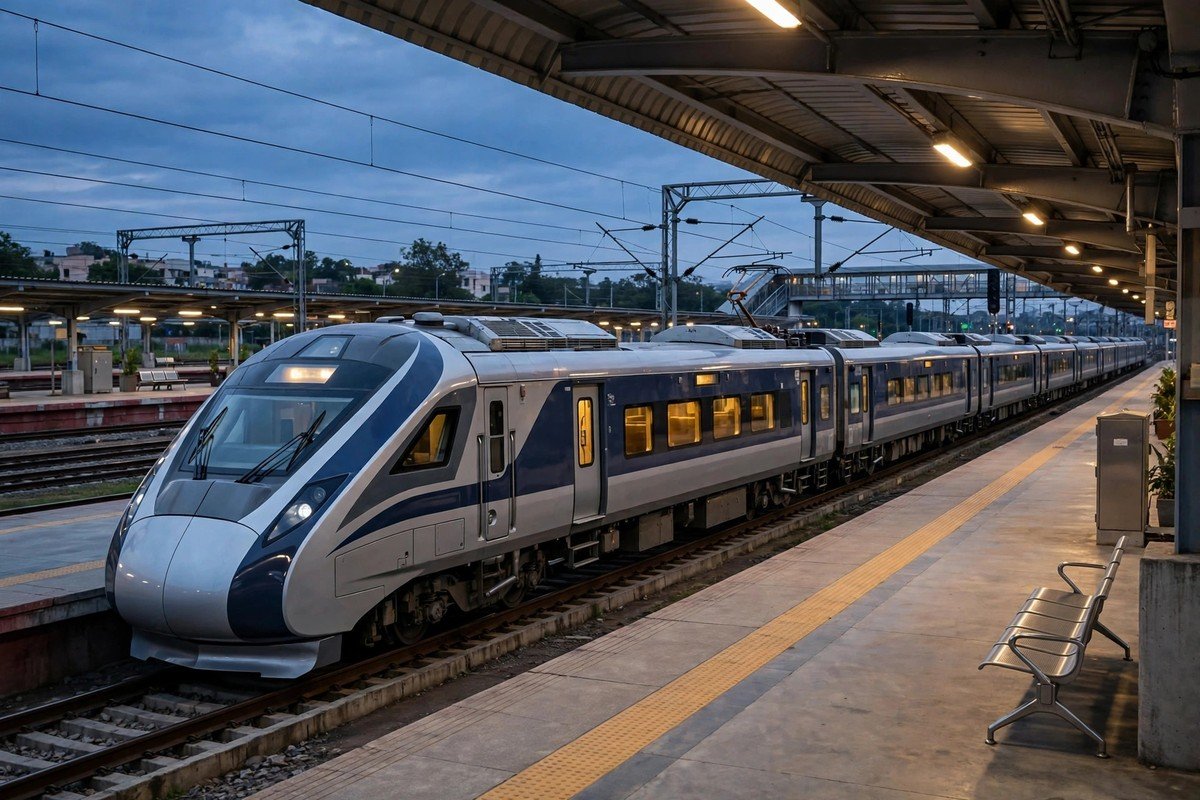
A new overnight option is now a reality between two of the country’s biggest economic centres. The Vande Bharat Sleeper Express between Sir M. Visvesvaraya Terminal in Bengaluru and Chhatrapati Shivaji Maharaj Terminus in Mumbai has been launched, giving passengers on this route a faster and more modern way to travel at night.
Until now, passengers on this route depended on long daytime journeys or conventional overnight trains. The new sleeper service leaves in the evening and reaches its destination before noon the next day. Passengers can board in the evening, spend the night on the train, and reach their work city in time to begin the next day. For business, study, medical and family travel, this timetable is particularly useful.
According to the Railways, the service will be operated by South Western Railway. Train number 27652 will run from Bengaluru to Mumbai, and train number 27651 will run from Mumbai to Bengaluru. Both directions will run six days a week, but the weekly off day is different in each direction. Understanding this difference is the most important thing for passengers, so that a booking is not made on the wrong day.
Flag-off on 1 November; inaugural run left in the afternoon
Railway Minister Ashwini Vaishnaw flagged off the Bengaluru-Mumbai Vande Bharat Sleeper Express from Sir M. Visvesvaraya Terminal in Bengaluru on 1 November 2026. The day is also observed as the formation day of Karnataka, which made the launch symbolically special for the state. As part of the launch programme, the inaugural run left Bengaluru for Mumbai at 12.15 pm.
One distinction needs to be made clearly. The inaugural run’s timing was different from the regular timetable. In regular service, the train from Bengaluru will leave in the evening, whereas on the launch day it left in the afternoon for the special programme. Passengers should therefore go by the evening timings for regular travel, not by the afternoon timing of the inaugural run.
This is reported to be the third Vande Bharat Sleeper service in the country. Vande Bharat Sleeper services have already begun on the Howrah-Kamakhya and Varanasi-Delhi routes. With the Bengaluru-Mumbai service, the modern sleeper network has now extended to southern India. The aim of all three services is the same — to make long-distance night travel faster, safer and more comfortable.
Regular service: from Mumbai today, from Bengaluru tomorrow
Regular commercial service begins on different dates in the two directions. In the Mumbai-to-Bengaluru direction, regular service begins this evening, 2 November 2026. In the Bengaluru-to-Mumbai direction, regular service begins on 3 November 2026. The difference follows from the weekly operating cycle, in which each direction has a different off day.
Train number 27651 from Mumbai to Bengaluru will leave Chhatrapati Shivaji Maharaj Terminus at 8.10 pm and reach Sir M. Visvesvaraya Terminal in Bengaluru at 12 noon the next day. This service will not run on Tuesdays. On the other six days, it will be available regularly.
Train number 27652 from Bengaluru to Mumbai will leave Sir M. Visvesvaraya Terminal at 7.45 pm and reach Chhatrapati Shivaji Maharaj Terminus in Mumbai at 11.55 am the next day. This service will not run on Mondays. On the other six days, passengers can use this service.
In terms of distance, the Bengaluru-to-Mumbai journey will take about 16 hours and 10 minutes, while the Mumbai-to-Bengaluru journey will take about 15 hours and 50 minutes. The total route length is reported to be about 1,118 kilometres. The timetable has been set so that passengers board in the evening and alight before noon the next day.
Route and eight stops: the states the train will pass through
The train will pass through three states — Karnataka, Andhra Pradesh and Maharashtra. Starting from Bengaluru, it will pass through stations in Andhra Pradesh, enter the northern part of Karnataka, and then reach Mumbai through Maharashtra. On the return journey, the same order will be reversed.
In regular service, the train will have eight intermediate stops. These are Anantapur, Guntakal, Raichur, Yadgir, Kalaburagi, Solapur, Pune and Kalyan. Of these, Anantapur and Guntakal are in Andhra Pradesh, Raichur, Yadgir and Kalaburagi are in Karnataka, and Solapur, Pune and Kalyan are in Maharashtra. Keeping the number of stops limited helps control the journey time and gives long-distance passengers a faster service.
Stops such as Pune and Kalyan will be particularly useful for passengers in western Maharashtra and the Mumbai metropolitan region. Passengers from Solapur and Kalaburagi will also be connected directly to Bengaluru and Mumbai. Earlier, passengers from these cities often had to depend on longer trains or travel in several stages.
Passengers should note that halts at intermediate stations will generally last only a few minutes. It is therefore important to be ready before one’s station and to keep luggage in order. Extra care is needed at night-time halts, because many passengers will be asleep at that hour.
Fare: three classes, bookings open since 1 November
The train will offer travel in three classes — First AC, Second AC and Third AC. The full-journey fare is Rs 2,810 in Third AC, Rs 3,630 in Second AC and Rs 4,450 in First AC. Goods and Services Tax will apply separately on these fares, so the final amount at the time of payment may differ slightly.
Bookings for tickets opened on 1 November itself. Passengers can book through the official website of the Indian Railway Catering and Tourism Corporation, railway reservation counters and the RailOne app. Before booking, passengers should check the date of travel, the direction, and the weekly off day, because the Monday and Tuesday rule differs by direction.
One more point about the fare needs to be understood. This is a premium sleeper service, so its fare is higher than that of ordinary sleeper or mail and express trains. In return, passengers get modern coaches, a faster journey and a convenient overnight timetable. When planning a journey, it makes sense to weigh fare, time saved and comfort together.
Passengers should choose their class thoughtfully while booking. Third AC has the largest number of berths, so the chance of getting a place there is higher. First AC has the fewest berths, so passengers travelling in this class should book well in advance.
Coaches and capacity: 16 coaches, 823 passengers at a time
The train will have 16 coaches in all, and 823 passengers will be able to travel at a time. Of these, 611 passengers will travel in Third AC, 188 in Second AC and 24 in First AC. The coaches have been designed keeping long night journeys in mind, so that passengers can travel while sleeping.
Vande Bharat Sleeper trains have been designed for speeds of up to 180 kilometres per hour, although the actual speed will depend on track conditions and route restrictions. This means the design capacity is higher, but it will not be possible to run at that speed on every section. Even so, limited stops and modern technology are expected to keep the total journey time lower than that of conventional trains.
For night travel, the berth facility matters the most to passengers. In a sleeper service, passengers can lie down and travel, which is a different experience from daytime chair-car travel. For long journeys, especially for elderly passengers, families travelling with children, and those travelling after a day’s work, this facility can be a major relief.
Why this service matters for passengers
Bengaluru and Mumbai are two of the country’s largest economic centres. Bengaluru is known for information technology, start-ups and research, while Mumbai is a centre of finance, film and trade. Every day, a large number of people travel between the two cities for business, jobs, study and medical care. For them, a fast overnight service is directly linked to time and convenience.
The biggest advantage of a night service is that the daytime is saved. Passengers board in the evening, travel at night, and reach their destination before noon the next day, ready to begin work. A daytime journey consumes the whole working day, whereas a night journey keeps the working day safe. This is why demand for sleeper services on long-distance routes remains constant.
The service also connects intermediate cities directly. Passengers from Raichur, Kalaburagi, Solapur and Pune will now be able to reach both metros without changing trains. This will make it easier for people from smaller cities to reach big cities, and will strengthen regional connectivity.
From the point of view of modernising travel, this service is also important. Along with safety technologies such as the Kavach system and modern coaches, Indian Railways is steadily giving long-distance travel a new form. Just as air travel has facilities such as Digi Yatra, this railway initiative shows that modes of travel in the country are modernising together.
Before you travel: three things to check
Before booking a ticket, check three things. First, the direction of travel — Bengaluru to Mumbai or Mumbai to Bengaluru — because the train numbers are different. Second, the weekly off day — the service from Bengaluru will not run on Mondays, and the service from Mumbai will not run on Tuesdays. Third, the timings — 7.45 pm from Bengaluru and 8.10 pm from Mumbai.
For the full timetable and stops, passengers can check the details available on official booking channels. The full timetable should be confirmed at the time of booking, because changes are possible during festivals or special occasions. Reaching the station well in time is also wise, so that there is no rush during night travel.
During night travel, take special care of luggage. Keep valuables with you, keep essential items in order near your berth, and avoid accepting food or drink from strangers. Passengers travelling with children and elderly people should try to book a lower berth or a convenient place in advance.
What next: all eyes on the first week of regular service
All eyes will now be on the first week of regular service. Service from Mumbai begins this evening, and service from Bengaluru begins tomorrow evening. The first week will make it clear how fast bookings are moving, how well the timetable is being followed, and what experience passengers are getting.
In new long-distance services, passenger response in the initial days decides the picture ahead. If passengers on the Bengaluru-Mumbai route like this service, it can become a permanent and reliable option for night travel. For now, passengers have a new, faster and more modern option — and from this week, they can begin using it regularly.
Disclaimer: This story has been prepared on the basis of available sources and verification. If any fact is found incorrect, a correction will be published.