








Desk Report
Diwali 2026 is now only four days away. The main festival, with Lakshmi Puja, will be celebrated on Sunday, 8 November 2026. To avoid last-minute rushing, it is wise to organise cleaning, decoration, puja samagri, shopping and safety preparations starting today. This checklist covers the whole festival week, so that every festival from 5 November to 11 November can be observed on time and in peace.
Diwali 2026 Date and Lakshmi Puja Muhurat
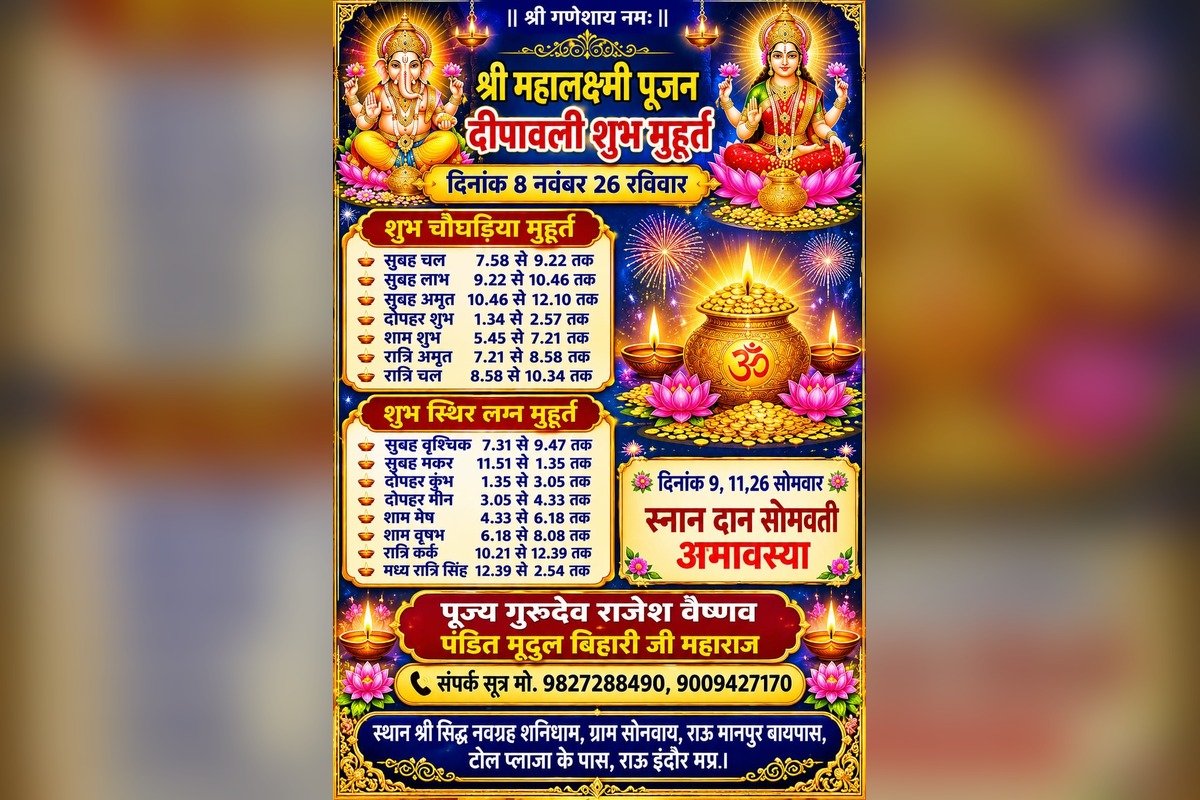
According to the panchang, the Kartik Amavasya tithi will begin at 11:27 AM on 8 November 2026 and continue till 12:31 PM on 9 November. Since the Amavasya tithi falls in the Pradosh Kaal on the evening of 8 November, the main Diwali will be celebrated on Sunday, 8 November itself. This settles the confusion over 8 versus 9 November — the main puja will be on the evening of 8 November, because by the evening of 9 November the Amavasya tithi will already have ended.
For Lakshmi Puja, the Delhi panchang gives an auspicious window from 5:54 PM to 7:50 PM on 8 November, a period of about 1 hour 56 minutes. The Pradosh Kaal on that day runs from 5:31 PM to 8:09 PM, and the Vrishabha Kaal coincides with the puja window. For families who follow the late-night tradition, the Nishita Kaal is given as 11:39 PM to 12:31 AM. Puja timings vary by city, so the Delhi timing cannot be applied directly to every city in Madhya Pradesh. According to the Ujjain panchang, the Lakshmi Puja muhurat on 8 November is from 6:09 PM to 8:07 PM. Differences of a few minutes due to local sunset and panchang calculation are normal, so readers in Madhya Pradesh should confirm the timing from their local panchang before finalising their puja schedule.
The Full Festival Week: 5 to 11 November Calendar
This year Diwali arrives as a long chain of festivals. Govatsa Dwadashi, or Vasu Baras, on 5 November opens the week. Dhanteras follows on 6 November, with Dhanvantari Puja, Yam Deepdan and the shopping tradition. Naraka Chaturdashi, observed as Chhoti Diwali, falls on 7 November. The main Diwali and Lakshmi Puja will be on 8 November. The morning of 8 November also carries the Roop Chaudas tradition of Abhyang Snan and ubtan, so that day has significance both in the morning and in the evening.
The Amavasya tithi will continue till noon on 9 November, but the main puja will already have been performed the previous evening. After that, Govardhan Puja will be celebrated on 10 November and Bhai Dooj on 11 November, closing the festival week. Planning with this full calendar in mind has a clear advantage: the samagri and timing for each festival can be fixed in advance, and no day becomes a rush. Sitting together as a family and deciding who will do what, and what needs to be bought in advance, makes the whole week smoother.
Start Four Days Early: Cleaning and Decluttering
Tradition holds that Lakshmi visits a clean and well-lit home, which is why Diwali preparation begins with cleaning. Start with the parts of the home that daily cleaning misses — the tops of cupboards, fan blades, window corners, the area around the puja place and the main entrance. Separating out old and broken items is also useful, as it creates space and leaves clean surfaces for decoration.
Along with cleaning, check electricity and safety arrangements. Extra lights, decorative strings and lamps are used during Diwali days, so check in advance that no wire is damaged, no plug is loose and the load arrangement is sound. If needed, get the checking done by a knowledgeable person. Clean the puja place separately and keep enough space free there, so that items do not have to be moved around during the puja itself.
Do not try to finish all the cleaning in a single day. Four days is a good span for dividing the work — the living room and main entrance on one day, the kitchen and store on another, the puja place and bedrooms on the third, and final decoration on the fourth. Do not burden elderly family members and children with heavy work, and take normal precautions against dust while cleaning.
Home Decoration: Rangoli, Toran, Diyas and Lights
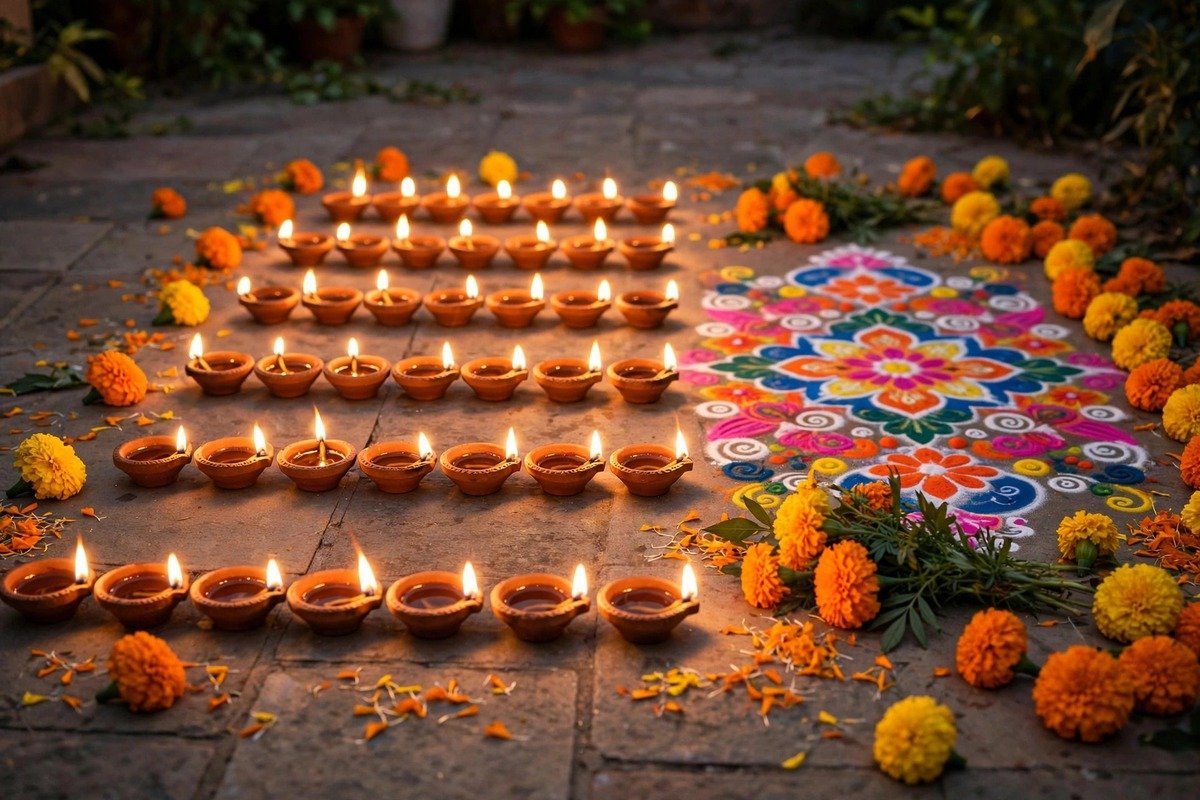
After cleaning comes decoration. Rangoli and toran at the main entrance are the signature of Diwali. For rangoli, flower petals, turmeric, rice flour and natural colours are good options. A rangoli made of flowers and natural material is better for the environment and also spreads a gentle fragrance in the home. A toran of mango and ashoka leaves at the main entrance is an old tradition.
Clay diyas are the biggest identity of Diwali. Diyas bought from local potters are connected to tradition and also give direct benefit to local artisans. Soaking clay diyas in water beforehand and drying them is useful, as they then absorb less oil. Keep diyas away from curtains, electric wires, wood and cloth, and never leave a lit diya unattended, especially before sleeping at night — check all diyas once before going to bed.
Take care with electric light strings as well. Avoid broken strings, exposed wires and overloaded arrangements. For outdoor decoration, keep the weather in mind — if wind or rain is likely, place paper decorations and light strings in safe spots. The purpose of decoration is to make the home beautiful, so avoid crowding it with more items than needed.
Complete Lakshmi Puja Samagri List
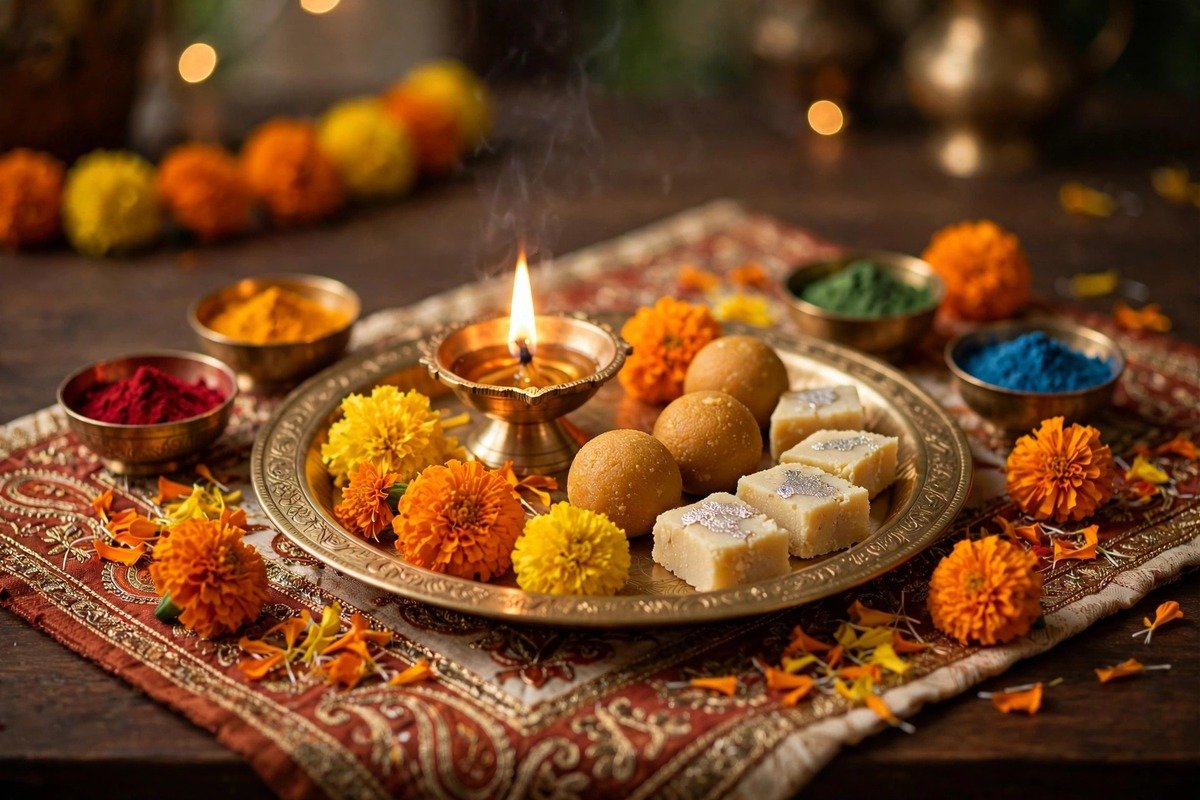
Preparing a list in advance is the best way to ensure that nothing is missing at puja time. For Lakshmi-Ganesh Puja, first of all an idol or picture, a chowki and a red or yellow cloth are needed. For the kalash, a copper, brass or clay kalash, mango leaves and a coconut with its husk are kept. For tilak and puja, roli or kumkum, turmeric, sandalwood paste, akshat or whole rice grains, kalawa, janeu and a red chunari are needed.
Among flowers, a lotus flower is considered good if available, along with marigold and rose garlands. Paan leaves, supari, cloves, cardamom, Ganga water and panchamrit made of milk, curd, honey, ghee and sugar are also part of the puja samagri. For lamps, keep clay diyas, cotton wicks, ghee and mustard or sesame oil ready in advance. One large lamp is kept as the main deep, which many homes keep burning through the night.
For bhog and prasad, khil and batashe are the traditional Diwali offering, along with sweets, fruits and dry fruits. Dhoop, agarbatti, camphor, a bell and an aarti thali should also be on the list. In trading families, there is a tradition of keeping a new bahi-khata or account book, a pen and the keys of the safe. Coins or a silver item are also kept in the puja in many homes. Every home has slightly different traditions, so keep from this list whatever is available, with devotion — feeling is considered the greatest samagri of all.
Shopping Guide: What to Buy Early, What to Buy Last
Dividing Diwali shopping into two parts is wise. Durable items — such as the idol, chowki, kalash, diyas, bell and puja thali — should be bought before Dhanteras, so that the last day is not spent searching for them. Fresh items such as flowers, fruits, sweets and coconut are better bought on Diwali day or a day before, so that freshness is maintained and wastage is reduced.
The tradition of buying gold, silver or utensils is linked to Dhanteras. In such purchases, always check the bill, hallmark and weight, and do not make a large purchase in haste without checking. For clothes and gifts too, shopping with a list is good, so that the same item is not bought twice and the budget stays under control. Buying from local markets and small shopkeepers ensures that the benefit of the festival reaches local people directly.
Take care with online shopping as well. While ordering anything, check the delivery date in advance, so that the item arrives before Diwali. For firecrackers, buy only from authorised and certified sellers and avoid any illegal or unchecked material. Keep all bills and receipts safely after shopping, so that they are available if needed later.
Safety First: Diyas, Electricity, Crackers and Children
Diwali is a festival of happiness, and its biggest condition is safety. Always keep diyas and candles away from flammable items and never leave children alone near diyas. During puja or celebrations, avoid loose and synthetic clothes; cotton and well-fitted clothes are considered safer. Keep a bucket of water, a blanket and a first-aid kit with burn medicine ready in the home in advance.
Following the rules on firecrackers is essential. For Delhi-NCR, the Supreme Court has allowed only certified green crackers on 7 and 8 November this year, in limited windows — 6 AM to 7 AM and 8 PM to 10 PM. Firecrackers are banned within 300 metres of hospitals, nursing homes, old-age homes and notified silence zones. This order is for Delhi-NCR; readers in Madhya Pradesh should follow the directions of their district administration and municipal body, and note any local restriction or time limit issued at the local level.
Certified green crackers can be identified by the CSIR-NEERI logo and QR code on the box, which can be scanned to check validity. Green crackers are not fully pollution-free, but they are claimed to cause less pollution than traditional crackers. Take special care of elderly people, children, sick persons and pets — loud noise and smoke can trouble them. Keep pets indoors in a safe place during firecrackers, with water and a quiet corner arranged in advance.
The Diwali Day Schedule: Morning to Night
Diwali day begins with morning traditions. On the morning of 8 November, the Roop Chaudas tradition of Abhyang Snan and ubtan is observed. After that, final cleaning, rangoli and main-entrance decoration are completed. By afternoon, it is good to keep all puja samagri ready in one thali, so that there is no rushing in the evening.
In the evening, the chowki is decorated at the puja place and the idol or picture of Lakshmi and Ganesh is installed. After kalash sthapana, the puja sequence proceeds and Lakshmi Puja is performed in the main muhurat. After the puja, diyas are placed in every corner of the home, near the tulsi plant, at the main entrance and on the roof. In many homes, the main deep is kept burning through the night. The night brings the tradition of sharing sweets and bhog with family.
While enjoying fireworks at night, do not forget safety rules either. Burst crackers only in an open ground, at a safe distance from others and under adult supervision. Bursting crackers under the influence of alcohol or any intoxicant can be dangerous, so it should be avoided completely. Before sleeping at night, check the whole home once — diyas, light strings and electrical appliances.
What Next: Govardhan Puja and Bhai Dooj Preparation
Even after Diwali, the chain of festivals continues. Govardhan Puja will be celebrated on 10 November, with the Annakut tradition linked to it. Bhai Dooj will follow on 11 November, when sisters apply tilak to their brothers and pray for their long life. Fixing the samagri and timing for both these festivals in advance is also good, so that no essential item is missed in the tiredness after Diwali.
For Govardhan Puja, the Annakut preparation, and for Bhai Dooj, the tilak thali, sweets and gifts, can be planned in advance. Families living in other cities can also plan travel or messages for Bhai Dooj ahead of time. In this way, the festival season becomes not just a one-day event but an organised and peaceful experience across the whole week.
In the end, the most important thing is that the real meaning of Diwali is light, cleanliness, meeting loved ones and sharing happiness. The more organised the Diwali 2026 preparation is, the calmer and more joyful the festival will be. Four days is enough time — make a list today, divide the work and complete the preparation little by little each day.
Disclaimer: This news has been prepared on the basis of available sources and verification. If any fact is found incorrect, a correction will be published.