







Beijing Bureau. OnePlus has taken the wraps off the OnePlus 16 in China, and this time the brief is unmistakably gaming: a display that pushes 185Hz, a trio of self-developed gaming chips, a 200-megapixel camera and the largest battery the company has ever put in a phone — 9,000mAh. The launch event revealed nearly every key specification. What it did not reveal was the price — or when India gets it.
Gaming first: the 185Hz display
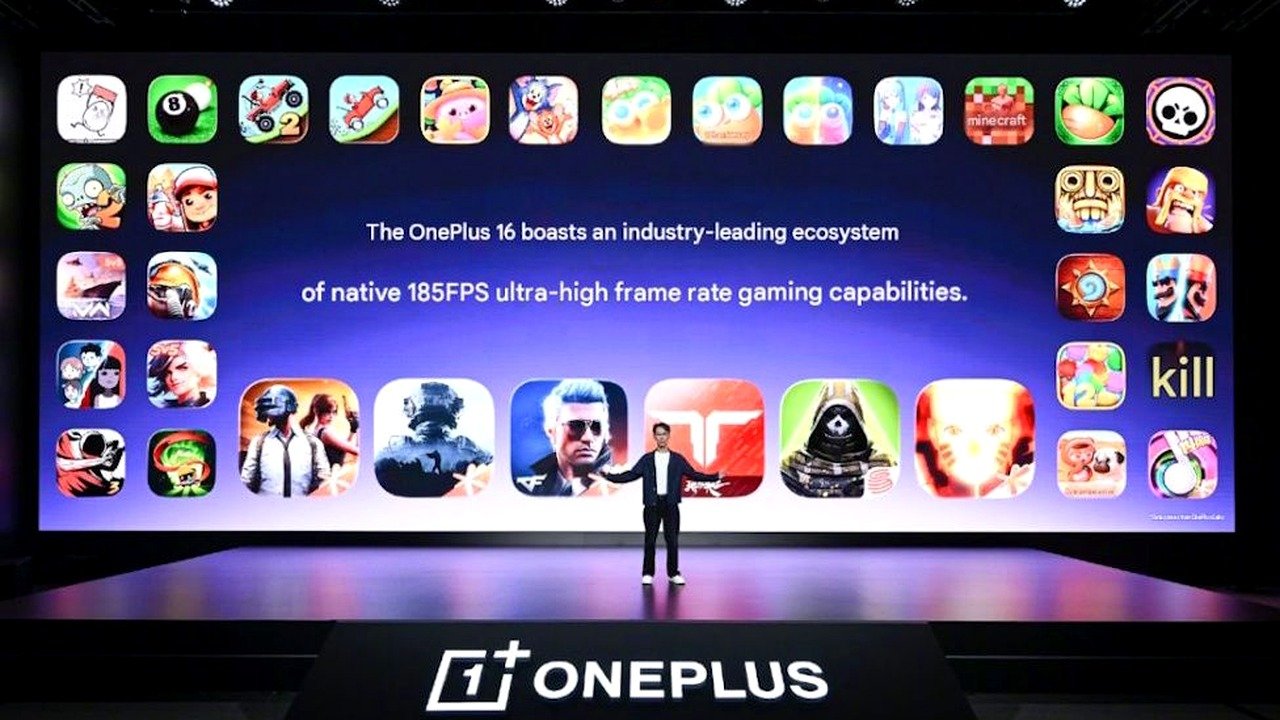
The headline act is the 6.78-inch AMOLED display, co-developed with BOE. It runs at 165Hz across the system — scrolling and animations stay fluid everywhere — and stretches to 185Hz in supported games. OnePlus claims several popular titles will run at a native 185 frames per second, including Peace Elite (the Chinese version of PUBG Mobile), Arena Breakout, CrossFire, Nizhan: Future and Naruto Mobile. Call of Duty Mobile gets 165FPS support, while Genshin Impact is promised 180+ FPS through frame interpolation.
OnePlus is treating gaming as a sport in itself: the OnePlus 16 has been named the official device of the next-generation Peace Elite pro esports league. Ahead of launch, the company ran a demonstration with a robotic arm testing ten devices identically — the OnePlus 16 won every round, though that was the company’s own marketing exercise rather than an independent comparison.
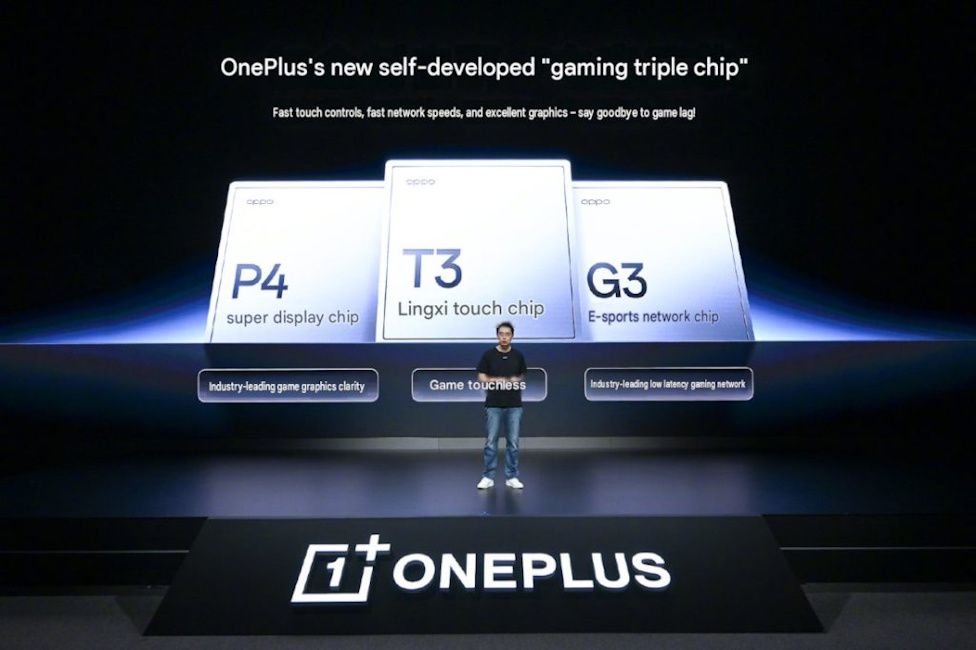
To keep frame rates stable over long sessions, OnePlus has built a new Fengchi gaming kernel that manages hardware resources — CPU, GPU and memory — so performance does not sag as the phone heats up. Alongside it sit three self-developed chips: the T3 touch chip, the P4 super display chip and the G3 esports network chip. The company says the P4 carries 20 percent more transistors with 25 percent better data throughput, while the G3 cuts average cellular gaming latency by 13.9 percent and improves Wi-Fi stability.
Silicon: Snapdragon 8 Elite Extreme Gen 6
Powering it all is Qualcomm’s new Snapdragon 8 Elite Extreme Gen 6, built on a 2nm process — placing it among the most advanced mobile processors of the year. The phone comes in 12GB and 16GB RAM variants with up to 1TB of storage; China pre-booking lists 12GB/256GB, 12GB/512GB, 16GB/512GB and 16GB/1TB configurations. For heavy gamers, large game libraries and relentless multitasking, that combination matters.
Cameras: the 200MP leap
The camera system is a big step up from the OnePlus 15. A 200-megapixel main sensor (1/1.4-inch) leads the setup, joined by a 50-megapixel ultrawide and a 50-megapixel periscope telephoto with 3x optical zoom. The front camera is a 50-megapixel autofocus unit. OnePlus is also introducing new imaging modes under its LUMO branding, including an XPAN-style mode and a Master mode.
For context, the OnePlus 15 shipped three 50-megapixel cameras, and its imaging drew criticism in flagship comparisons. A 200-megapixel sensor typically bins pixels together for a cleaner, brighter image — so it will not shoot at 200MP every time, but low-light results should improve. The true test will come in reviews, particularly telephoto quality, where phones face their toughest challenge.
Battery and charging: biggest ever, slightly slower
The 9,000mAh Glacier battery is the largest OnePlus has ever fitted — and among the largest in any flagship. It is paired with an Oppo-developed power-management chip claimed to improve efficiency and slow battery wear. Charging is 100W wired and 50W wireless (Qi).
There is a trade-off: the OnePlus 15 charged at 120W wired, now down to 100W. Filling the much larger cell will take a little longer — overnight chargers will not notice, but fast-charging enthusiasts will. OnePlus has not yet disclosed the full-charge time, which will settle the question.
Design, durability and software
The phone comes in three finishes — Tomorrow’s Starlight, Dark Forest and Mars Masterpiece — carrying forward the OnePlus 15’s design language, with one finish adding three lighting zones that glow orange-yellow for notifications. Durability is serious: IP66, IP68, IP69 and IP69K ratings, with IP69K guarding against high-pressure, high-temperature water jets. There is Oppo’s Crystal Shield Glass, an ultrasonic fingerprint sensor, stereo speakers and a USB 3.2 Gen 1 Type-C port. In China it runs ColorOS 17 on Android 17.
Price and India: the open questions
The biggest question — price — remains unanswered. OnePlus did not announce China pricing; some reports point to around CNY 4,999 (roughly ₹62,000), but that is unconfirmed. Pre-booking is open in China, with open sales starting 13 October.
India’s picture is equally hazy. Some reports suggest a November-to-January window; others say the more affordable OnePlus 16R could arrive first — or that the standard model may skip India altogether. The company has already ruled out new launches in North America and Europe. Rising memory prices have pushed phone costs up this year — the OnePlus 15 launched in November 2025 at ₹72,999 and now sells at ₹85,999 — so pricing pressure on the OnePlus 16 will be real. For now, Indian buyers wait; the OnePlus 15 remains on sale, and the iQOO 15 is already available as its closest rival.