




Bengaluru Bureau
Summary: India’s first indigenous bullet train is now taking shape inside a factory. At Bengaluru, the integrated car body of the B28 trainset is ready, and the final stage of squeeze testing is under way to check its strength. The 8-coach train, with seating for 557 passengers and a design speed of 280 kilometres per hour, is being built for the Mumbai-Ahmedabad high-speed corridor.
The dream of high-speed rail in India is no longer only on paper. At the BEML manufacturing unit in Bengaluru, the body of the country’s first indigenous bullet train is ready. Railway Minister Ashwini Vaishnaw visited the unit on 1 November and inspected the construction work. He examined everything from the making of the car body to passenger seats, the air-conditioning system and other equipment. During the visit, a glimpse of the train’s structural design was also shared, showing the roof, side walls, cab and end walls.
What was seen during the inspection in Bengaluru
During the inspection, the minister looked at the specialised manufacturing infrastructure used to build the car body. This includes precision-engineered jigs and fixtures that give the different parts of the car body their exact shape. Key production stages such as the underframe, sidewall, roof assembly, car assembly, surface preparation and treatment were also reviewed.
The construction of side modules and roof modules, their integration and assembly operations were examined as well. The minister said the work on all major components of the train — manufacturing, integration and testing — is proceeding according to set technical standards. He expressed satisfaction with the progress of the work and described it as excellent progress.
What is B28: 8 coaches, 557 passengers, 202 metres
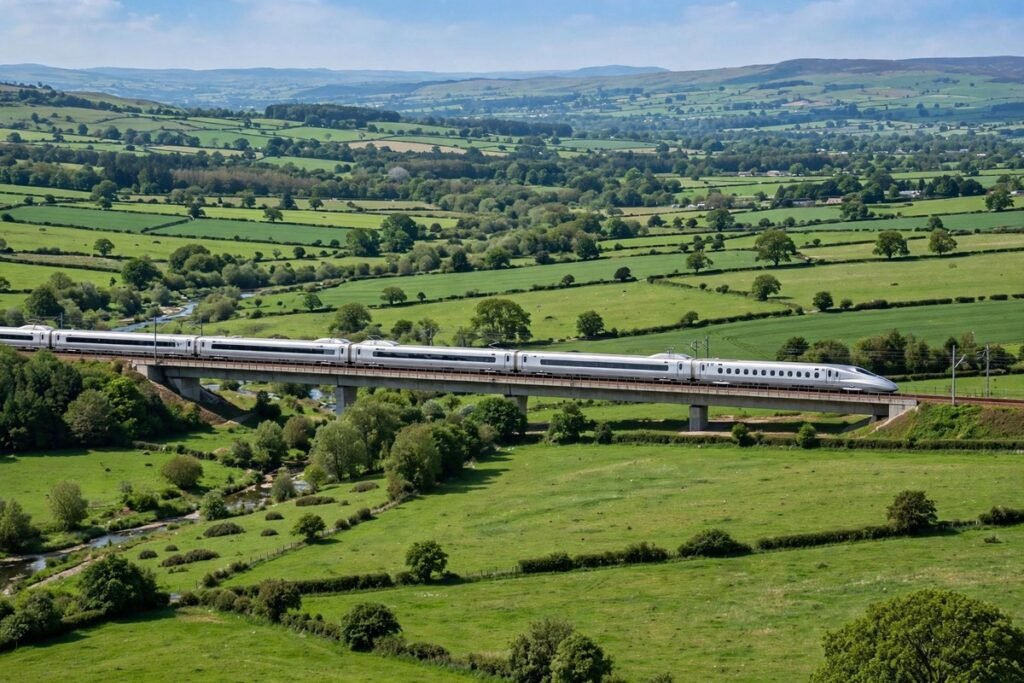
B28 is India’s first indigenously designed high-speed trainset. It is being built by the Integral Coach Factory and BEML together. The trainset will have 8 coaches in total. It will be about 202 metres long and will have seating capacity for 557 passengers.
The formation includes four motor cars and four trailer cars. The design has been prepared keeping Indian conditions in mind, with special emphasis on passenger comfort, safety, accessibility and energy efficiency. The train will run on a 25 kV AC traction system and will use regenerative braking technology, which recovers energy when the brakes are applied.
What is the squeeze test, and why does it matter
After the car body is ready, its strength is now being tested. This is called the squeeze test. In this test, the car body is subjected to controlled compressive and tensile forces. This checks how strong the structure is, how rigid it is, and whether its shape and dimensions remain within the required standards.
This test is especially important for a high-speed train because the air pressure around the train changes sharply when it runs at high speed. The minister explained that when a train runs at very high speed, a vacuum-like condition forms around it. That is why the whole structure has been designed to international standards and is being put through the strictest squeeze test.
Once the car body testing is complete, the propulsion system, electronics, motors and other essential equipment will be fitted. Bogies and related assemblies will also be fitted under the train. In other words, the body that is ready now will later become a fully working train.
The speed maths: 280 design speed, about 250 operating speed
B28 is being prepared for a maximum design speed of 280 kilometres per hour. Its operating speed is being kept at about 250 kilometres per hour. Some reports put the operating speed at 249 kilometres per hour, which is broadly the same level. Keeping a gap between design speed and operating speed is normal practice for high-speed trains, so that an adequate safety margin remains.
In terms of speed, this train will be far ahead of the fastest passenger trains currently running in India. The reduction in journey time on long routes will become visible only when the train enters regular service on its planned corridor, but the direction of travel is clear: India is moving from conventional fast trains towards true high-speed rail.
Passenger comfort is part of the design
Building a bullet train is not only about achieving speed. Passenger comfort is also a major part of the work. During the inspection, the minister examined passenger seats, the heating, ventilation and air-conditioning system, couplers and other equipment.
In a train running at high speed, seat design, cabin temperature, vibration and noise directly shape the passenger’s experience. That is why special attention is being given to these aspects in the train’s engineering. Keeping noise low inside the cabin, keeping temperature steady and controlling vibration are basic requirements of high-speed travel, and work on them has begun at the car body stage itself.
The weather test: from 50 degrees heat to below freezing
In a country like India, varied weather and geography pose a major challenge for a train’s systems. Keeping this in mind, climate testing of the train is planned. In this testing, the train will be examined in conditions ranging from scorching heat of about 50 degrees to temperatures below freezing point.
Its systems will also be tested in dusty conditions and in rain. The testing will check whether different equipment keeps working well even after continuous exposure to rain and water. This testing is necessary because the train is being built to run in different parts of the country, in different weather conditions.
The Mumbai-Ahmedabad corridor: a 508-kilometre journey
B28 is being built for the Mumbai-Ahmedabad high-speed rail corridor. This corridor is about 508 kilometres long. The full corridor is expected to be completed around 2029-30.
Under the tentative plan, the first run of the train could take place on 15 August 2027 on the Surat-Vapi section. This section is about 97 kilometres long. Track trials are expected by the middle of 2027. These dates are still tentative and may change depending on the progress of construction and testing.
Earlier, the plan was to buy Shinkansen trainsets from Japan for this corridor. Now the path of building an indigenous trainset has been chosen. This will develop India’s capacity in high-speed rail manufacturing, testing and maintenance. The work going on at the BEML unit is part of this capacity building.
The other big rail news of the same day: Bengaluru-Mumbai Vande Bharat Sleeper
On the same day as the B28 inspection, another major rail development was reported. The minister flagged off the first journey of the Bengaluru-Mumbai Vande Bharat Sleeper Express. The 16-coach train’s inaugural special departed from Sir M Visvesvaraya Terminal in Bengaluru and was scheduled to reach Chhatrapati Shivaji Maharaj Terminus in Mumbai at about 6:15 AM on 2 November.
Regular services of this train are beginning on 2 November. Train number 27652 will run between Bengaluru and Mumbai six days a week, except Mondays. It will depart Bengaluru at 7:45 PM and reach Mumbai at 11:55 AM the next day. In the return direction, train number 27651 will depart Mumbai at 8:10 PM and reach Bengaluru at noon the next day, running six days a week except Tuesdays.
In regular service, the train will stop at Anantapur, Guntakal, Raichur, Yadgir, Kalaburagi, Solapur, Pune and Kalyan. The 16-coach formation includes eight motor car coaches and four trailer car coaches. The service will give passengers a comfortable overnight travel option between two of India’s biggest cities.
What happens next
For B28, the most important phase now is testing. After the squeeze test, equipment fitting, climate testing and track trials will follow. Rollout is expected by the end of the year or early next year. Only after that will the train be considered ready for passenger service.
For India, this project is not limited to building one train. It is developing the country’s capacity in car body manufacturing, module integration and quality testing. The same experience will be useful for other high-speed projects in the coming years. The B28 taking shape in Bengaluru is the first major step in that direction.
Another recent travel-technology development in India is covered here.
A major clean-energy event is also being held in Delhi this week; read about it here.
The latest update on the indigenous bullet train is available here.
Disclaimer: This news has been prepared on the basis of available sources and verification. If there is any error in any fact, a correction will be published.