
Desk Report
Summary: Govardhan Puja 2026 will be celebrated on Tuesday, 10 November. Kartik Shukla Pratipada begins at 12:31 pm on 9 November and ends at 2 pm on 10 November. As per the Udaya Tithi rule, the festival falls on 10 November. The morning puja muhurat is from 6:40 am to 8:50 am. The day is marked by worship of Govardhan hill, Krishna and cows, along with the Annakoot offering.
Govardhan Puja holds a special place in the series of Diwali festivals. The celebrations that begin with Dhanteras continue beyond Diwali, and Govardhan Puja turns into a festival of gratitude towards food, nature and cows. This year, Diwali will be celebrated on 8 November, and two days later, on 10 November, comes Govardhan Puja and Annakoot. Usually Govardhan Puja falls on the day after Diwali, but this year the sequence of tithis creates a gap of one day, which has raised questions about the correct date. The position as per the panchang is clear, and this article is based on it.
Govardhan Puja 2026 date and shubh muhurat
Govardhan Puja is observed every year on Pratipada of the Shukla Paksha in the month of Kartik. In 2026, Pratipada begins at 12:31 pm on 9 November and ends at 2 pm on 10 November. Since Pratipada is present at sunrise on 10 November, the festival will be celebrated on Tuesday, 10 November, as per the Udaya Tithi rule. On 9 November, Amavasya prevails during the daytime, so Govardhan Puja will not be observed on 9 November.
The shubh muhurats for puja on 10 November are as follows. The morning puja muhurat is from 6:40 am to 8:50 am. Abhijit Muhurat is from 11:43 am to 12:26 pm. Godhuli Muhurat is from 5:30 pm to 5:56 pm. These timings are based on the Delhi panchang. Timings may vary slightly from city to city according to local sunrise, so it is advisable to confirm the time from the local panchang or temple. Many families perform the puja in the morning muhurat, while others follow the tradition of worship in the afternoon or evening.
Why Govardhan Puja is celebrated: the katha
The story of Govardhan Puja belongs to the Dwapar Yuga. According to belief, the people of Braj worshipped Indra every year for good rainfall. Young Krishna told the people of Braj that Govardhan hill, on which the cows grazed and from which fruits, flowers and water came, deserved worship, since it sustained their lives. The people of Braj then worshipped Govardhan hill instead of Indra.
Angered by this, Indra unleashed torrential rain over Braj. Krishna then lifted the entire Govardhan hill on his little finger and kept the people and animals of Braj safe beneath it for seven days. After seven days, Indra realised his mistake and the rain stopped. In memory of this event, Govardhan Puja is celebrated every year on Kartik Shukla Pratipada. The story teaches humility, giving up ego, and gratitude towards nature.
Significance of Govardhan Puja: gratitude towards nature, cows and food
Govardhan Puja is not merely a religious ritual; it is a festival of gratitude towards nature. Hills, rivers, forests, fields and cows are the foundations of life, and this festival expresses thanks to them. For farming communities, the festival has special meaning, as it celebrates the new harvest and the prosperity linked to livestock.
On this day, cows are worshipped with special devotion. They are decorated, offered fodder, and served with care. It is believed that observing Govardhan Puja brings growth of food and wealth in the home and keeps peace in the family. From an environmental point of view too, the festival carries a message: protecting hills, forests and water sources is protecting life itself. Without conservation of nature, prosperity cannot last.
How to perform Govardhan Puja at home
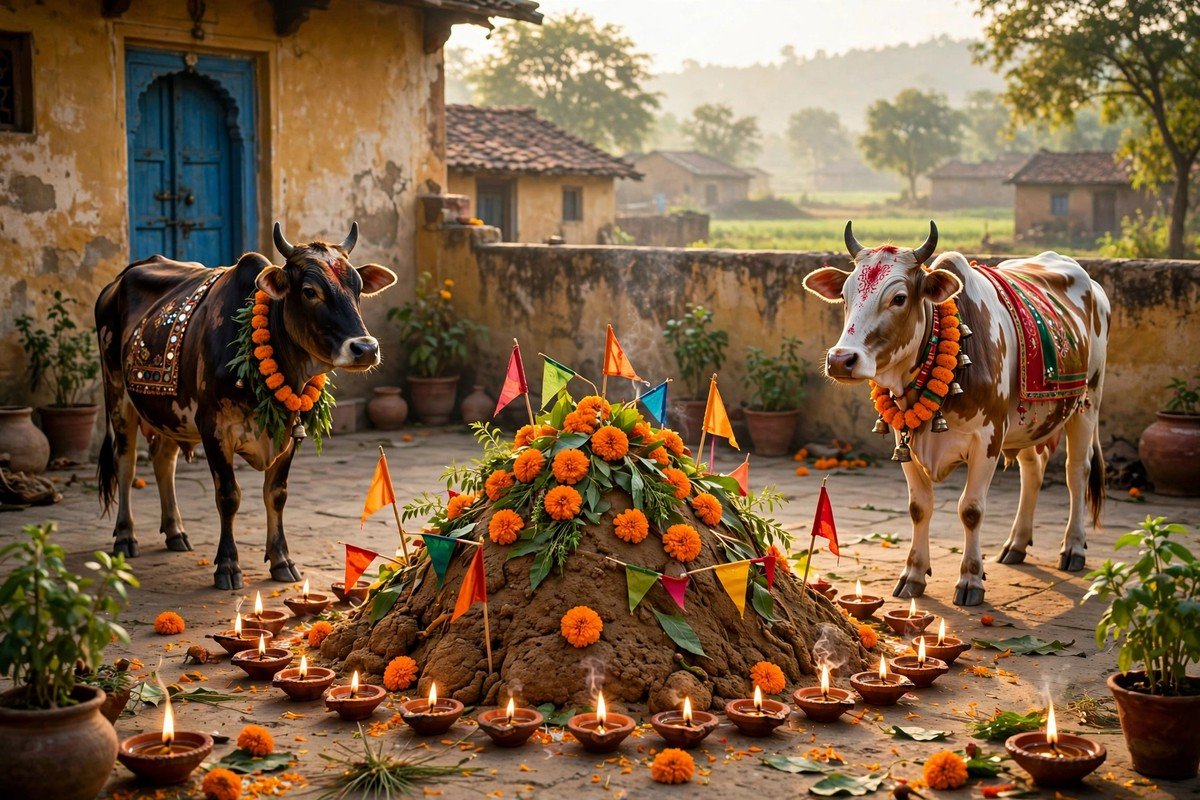
The method of Govardhan Puja at home is simple and traditional. Take a bath early in the morning, wear clean clothes, and clean the house and courtyard. Then, in the courtyard or puja place, make a model of Govardhan hill from cow dung. In many homes it is shaped like a reclining man, while in others it is made in the shape of a hill. Decorate the model with flowers, roli and akshat.
In the centre of the model, at the place of the navel, make a small bowl or hollow in which milk, curd, honey and batashe are placed during the puja. Around it, draw small lines of cow dung as a fence, symbolising the village of Braj. Then perform the puja with roli, rice, flowers, water, incense and lamps, remembering Krishna. Circumambulate the Govardhan model seven times and perform the aarti. At the end, pray to Govardhan Maharaj for happiness and peace in life and seek forgiveness for any lapse during the puja.
The materials needed for the puja include cow dung, flowers, flower garlands, roli, akshat, lamps, incense, Ganga water, milk, curd, honey, batashe, fruits, sweets and kheer. Keeping the materials ready in advance helps the puja proceed calmly.
Annakoot and Chhappan Bhog: the offering of food
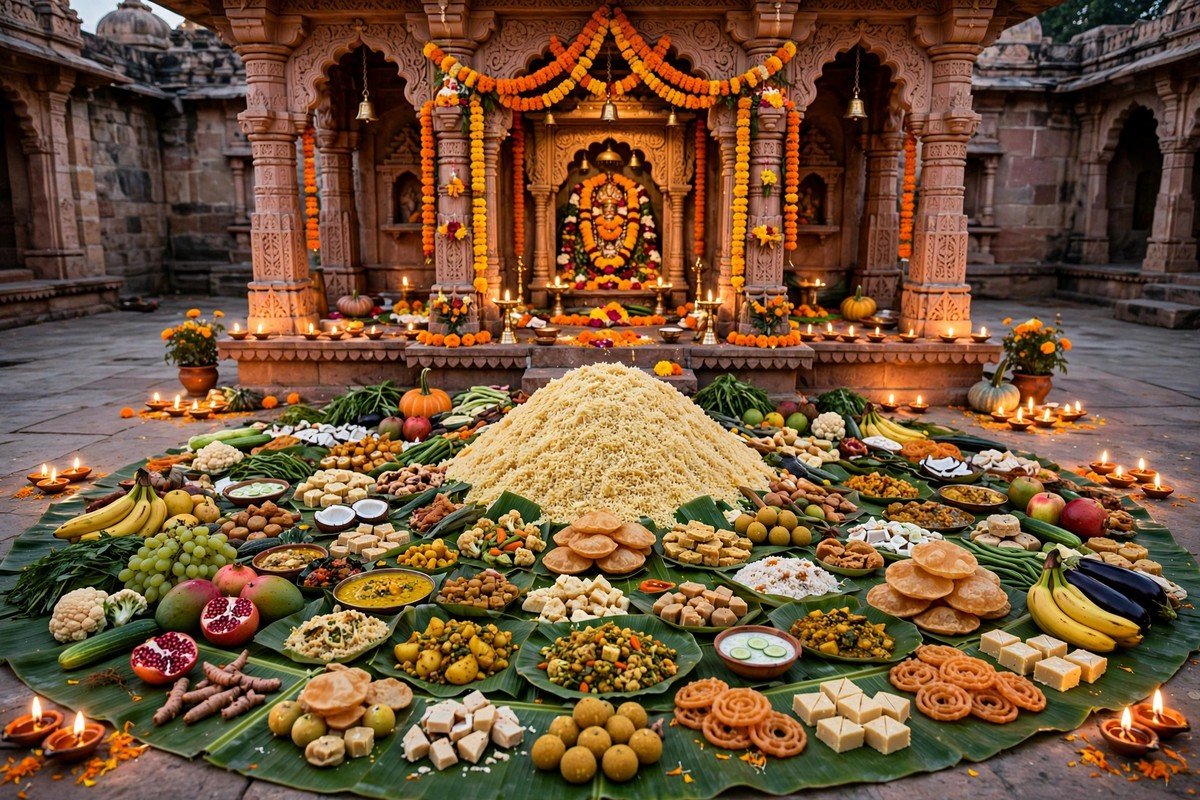
Govardhan Puja is also known as Annakoot. The word Annakoot means a heap of food. On this day, homes and temples prepare many kinds of dishes, grains, sweets and seasonal vegetables. All these are combined and offered to Krishna as bhog. In many temples, the tradition of Chhappan Bhog is followed, in which 56 kinds of dishes are offered.
The Annakoot offering symbolises gratitude for the harvest and abundance. At the time of the new crop, heaping up food, offering it first to the divine, and then distributing it as prasad among all is the soul of this festival. In temples, Annakoot prasad is distributed among devotees, and in homes, all family members share it together. The tradition carries the message of sharing food and celebrating together.
Cow worship and gau-seva on this day
On Govardhan Puja, worship of cows is prescribed. Cows are bathed, decorated, garlanded and worshipped, and fed good fodder. In many places, special programmes are held in gaushalas, and people also donate for gau-seva. Serving cows on this day is considered an especially virtuous act.
In rural areas, livestock owners decorate their animals on this day and the village wears a festive look. In cities too, temples and gaushalas organise Govardhan Puja programmes, where devotees take part in the puja and Annakoot prasad. For children, the festival is also an opportunity to learn love towards nature and animals.
Things to keep in mind during the puja
A few things are worth keeping in mind during Govardhan Puja. First, do not remain confused about the date and muhurat: this year the festival is on 10 November, not 9 November. Second, muhurat timings may vary slightly by city, so checking the local panchang is better. Third, maintain cleanliness and purity in the puja and use fresh and sattvik materials for the bhog.
While preparing Annakoot prasad, pay special attention to hygiene, since the prasad is distributed among a large number of people. While lighting lamps, take care of fire safety and keep dry materials away from the puja place. Buying festive items from local artisans and shopkeepers also adds to the joy of the festival.
Govardhan Puja in the Diwali festival series
The Diwali festival series begins with Dhanteras. This year, Dhanteras will be celebrated on 6 November, and the main festival of Diwali, Lakshmi Puja, will fall on 8 November. After that, Govardhan Puja and Annakoot will come on 10 November, and the series will conclude with Bhai Dooj. The whole week thus becomes a time of festivals, puja, shopping and family gatherings.
Preparations for Govardhan Puja begin during the Diwali days themselves. Demand for puja materials, flowers, clay diyas and sweets rises in the markets. Families prepare the list of dishes for Annakoot in advance. The message of the festival is straightforward: express gratitude for what nature and food have given, and celebrate by sharing it with everyone.
Govardhan Puja also reminds us that devotion is not limited to the temple. Worship of the hill, the cow, the field and food means respect for the foundations of life. That is why this festival is still celebrated with equal devotion in villages and cities alike.
Disclaimer: This news has been prepared on the basis of available sources and verification. If any fact is found incorrect, a correction will be published.