


Bhopal Bureau
Summary: Just before Diwali, sanitation workers from across Madhya Pradesh held a statewide protest in Bhopal, the state capital. Workers gathered at Neelam Park demanding a pay hike and the regularisation of contract and temporary staff. Organisers claim that 8,000 to 10,000 workers joined the protest, and have warned of an indefinite strike from 4 November if their demands are not met.
Diwali is close, and all eyes are on the cleanliness of cities. At such a time, this statewide protest by sanitation workers has also become a major challenge for the administration, because a strike could affect the sanitation systems of municipal corporations, municipalities and town councils. This report carries the details of the protest, the demands, the strike warning and what happens next.
Where the protest took place and under whose banner
On Tuesday, 3 November, sanitation workers held a statewide demonstration at Neelam Park in Bhopal. The protest was organised under the banner of the Akhil Bharatiya Safai Mazdoor Trade Union. Workers from the state capital and from various districts reached Bhopal to take part in it.
Neelam Park has long been a known venue for demonstrations in Bhopal. Several employee organisations and aspirants have held protests there in the past. Sanitation workers also chose the same venue to take their demands to the government. During the protest, workers also raised slogans in support of their demands.
According to the organisers, the purpose of the protest is not only to register dissent but also to draw the government’s attention to the condition of workers who handle the cleaning of cities every morning. They say that no concrete decision has been taken on their demands for a long time, which is why they had to take the path of protest.
How many workers gathered, and what organisers claim
Organisers claim that 8,000 to 10,000 sanitation workers gathered at Neelam Park in Bhopal on 3 November. This figure is based on the organisers’ claim; it is not being presented here as an officially counted number. Given the participation of workers from various districts, the protest has been described as a statewide movement.
The protest included workers employed in municipal corporations, municipalities and town councils. Contract workers and temporary workers were present in large numbers. It is this section that is raising the demand for regularisation most strongly, because even after years of working on a temporary arrangement, their service status has not become permanent.
Workers taking part in the protest say that they are the backbone of the urban sanitation system. From early morning till late evening, the cleaning of roads, lanes, markets and public places runs on their work. During festivals, this work increases further, because crowds grow in markets and the quantity of waste also rises.
What are the main demands of the workers
Two demands stand at the top of the workers’ list: a pay hike and regularisation. Workers say that with rising prices, it has become difficult to run a household on the present wages, and therefore wages should be increased.
The second major demand is the regularisation of contract and temporary workers. Workers say that those who have been doing sanitation work regularly for years should get the benefit of permanent service. Regularisation brings stability not only in wages and allowances but also in other service-related benefits.
In addition, workers have also raised the demand for improvement in their service conditions. Organisations taking part in the protest say that attention should also be paid to the working conditions, safety and dignity of sanitation workers. They say that sanitation work is extremely important for society, but the workers doing this work do not get the respect and facilities they deserve.
Warning of an indefinite strike from 4 November
During the protest, the union warned that if the government does not take a positive decision on the demands, an indefinite strike could begin from 4 November. This warning was repeated by Maganlal Jhanjhot, the state president of the Akhil Bharatiya Safai Mazdoor Trade Union.
The timing of the strike warning is also significant, because Diwali is near. During the festival, the demand for cleanliness in cities rises. Keeping markets, temples and public places clean becomes an even bigger responsibility for the administration. In such a situation, a strike could directly affect the sanitation system.
This warning is, for now, only a warning; the strike has not yet begun. What happens in the coming days will depend on the direction of talks between the government and the workers’ organisations. In this report, the strike warning is presented as a statement by the organisers, not as a decided course of events.
What impact could it have on the sanitation system
If an indefinite strike begins from 4 November, it could affect the sanitation systems of urban bodies across the state. There is an apprehension that sanitation and other essential work in municipal corporations, municipalities and town councils could be affected.
Cities generate a large quantity of waste every day. Collecting waste from homes, markets, hotels and public places on time and disposing of it is a continuous process. Even a day’s delay leads to piling up of waste, which can increase filth, foul smell and health-related problems.
During Diwali, this challenge grows further. During the festival, shoppers crowd the markets, homes are cleaned and old items are thrown out. At such a time, the role of sanitation workers becomes even more important. This is why the protest and the strike warning have increased the administration’s concern.
What is the position of the government so far
As this report was written, no official reaction from the government or the concerned department had come on the demands raised in the protest. The government’s side could not be carried in this article because no official statement was available on the matter. As soon as any official reaction comes from the government or the department, it can be added to this story.
Usually, after such movements, a round of talks begins between the government and workers’ organisations. In talks, the feasibility of demands, their financial impact and the process of implementation are discussed. Issues like regularisation involve policy decisions, availability of posts and financial provisions, so a decision on them can take time.
For the administration, the biggest priority at present is that the sanitation system of cities remains intact during Diwali. For this, work will be needed both on alternative arrangements and on talks.
Why the role of sanitation workers matters
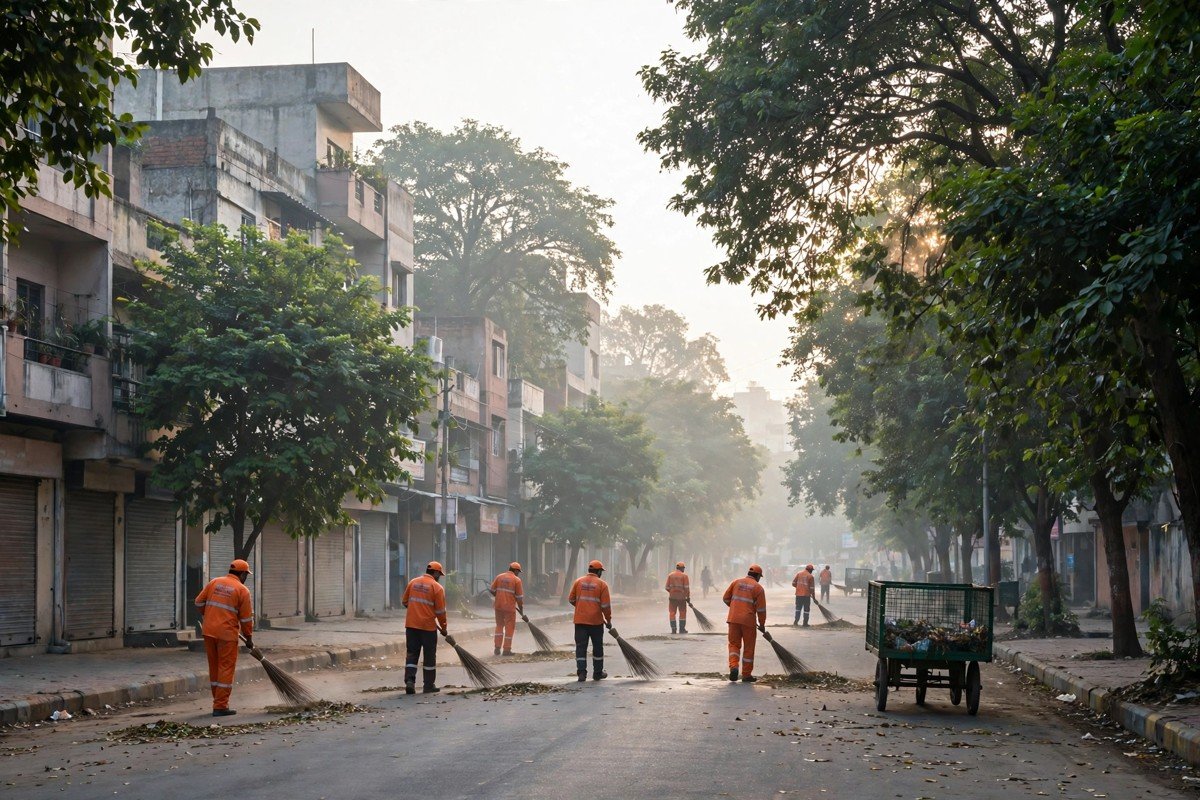
Sanitation workers are an essential part of the daily functioning of cities. Even before morning, these workers get busy cleaning roads and lanes, so that the city looks clean at the start of the day. Cleaning of market areas before shops open, upkeep of public toilets and waste collection run on the work of these workers.
Cleanliness is directly linked to public health. If waste is not collected on time, the risk of mosquitoes and diseases increases. In the rainy season, if drains are not cleaned, the problem of waterlogging also grows. That is why the work of sanitation workers is considered not just a service but also the first line of public health.
Cities like Indore have built a nationwide identity in cleanliness, and the hard work of sanitation workers has been a major reason behind that identity. Other cities of Madhya Pradesh are also trying to move ahead in cleanliness, in which the role of sanitation workers is central.
What happens next, and what to watch
In the coming days, all eyes will be on whether talks take place between the government and the workers’ organisations, and if they do, what outcome emerges. The date of 4 November is important because the warning of an indefinite strike has been given from that day.
If talks produce a solution, the strike may be averted and the sanitation system may remain normal during Diwali. If talks do not take place, or no agreement is reached in them, pressure on the sanitation system of cities could increase in the event of a strike.
The demands of the workers, the reaction of the government and the status of the strike — further news will depend on these three. Meanwhile, workers taking part in the protest have made it clear that their demands are limited to a pay hike and regularisation, and that they want a solution through talks.
Disclaimer: This news has been prepared on the basis of available sources and verification. If any fact is found incorrect, a correction will be published.