



Desk Report
Summary: The five-day Diwali festival ends with Bhai Dooj, a celebration of the bond between brother and sister. This year, Bhai Dooj will be observed on Wednesday, 11 November 2026. According to popular belief, on this very day Yamraj, the god of death, visited the home of his sister Yamuna, and pleased by her tilak and hospitality, he granted a boon that a brother who receives his sister’s tilak and shares her food on this day need not fear untimely death. That story is considered the root of the tilak tradition of Bhai Dooj.
Bhai Dooj 2026: Date and Tilak Muhurat
Bhai Dooj is observed every year on the Dwitiya tithi of the Shukla Paksha in the month of Kartik. It is also known as Bhaiya Dooj and Yam Dwitiya. According to the panchang, this year the Dwitiya tithi begins at 2 pm on 10 November 2026 and ends at 3:53 pm on 11 November 2026. On the basis of the udaya tithi, the main festival will be celebrated on Wednesday, 11 November.
The afternoon period, known as aparahna, is considered special for applying the tilak to a brother. As per general calculations, the auspicious time for tilak on 11 November will be from 1:10 pm to 3:20 pm. Sisters can perform the puja and tilak for their brothers at any time during this window. The exact timing may vary by a few minutes from city to city and as per the local panchang, so the muhurat given in one’s own city’s panchang should be treated as final. Some local calendars also carry the date of 10 November, but on the basis of udaya tithi, the main festival falls on 11 November.
Bhai Dooj is the last of the five days of Diwali. The festival that begins with Dhanteras passes through Narak Chaturdashi, Diwali and Govardhan Puja before concluding with Bhai Dooj. That is why Bhai Dooj is seen not merely as a ritual, but as the family conclusion of the entire festival of lights.
The Katha of Yamraj and Yamuna
According to the popular mythological story, Yamraj and Yamuna were the children of Surya, the sun god. Yamraj became the god of dharma and death, while Yamuna came to be revered as a sacred river on earth. Yamuna loved her brother deeply and repeatedly invited him to her home for a meal. But Yamraj remained so busy with his duties that he could not visit his sister even when he wished to.
It is believed that one day, after a long time, Yamraj arrived at Yamuna’s home on the day of Kartik Shukla Dwitiya. Yamuna welcomed him with great joy. She washed his hands and feet, applied a tilak on his forehead, performed his aarti and served him food with love. Pleased by his sister’s affection and hospitality, Yamraj asked Yamuna to seek a boon.
Yamuna then prayed that any brother who visits his sister’s home on this day, receives her tilak with love and partakes of the food cooked by her hands, should have no fear of untimely death and should enjoy an auspicious life. Yamraj accepted his sister’s wish. It is believed that since then, Kartik Shukla Dwitiya has been celebrated as Yam Dwitiya, that is, Bhai Dooj. This is also the reason the festival is called Yam Dwitiya.
The Yamuna Snan and the Significance of the Boon
Connected with this story is another belief — that taking a bath in the Yamuna river on this day carries special significance. It is believed that Yamraj’s boon also covered the brother who visits his sister’s home with affection and bathes in the Yamuna, granting him long life and auspiciousness. That is why the tradition of Yamuna snan is also observed at many places on Bhai Dooj.
The story carries a deeper lesson beyond religion. It teaches that no matter how busy life becomes, finding time for relationships is itself the highest duty. The visit of even a busy deity like Yamraj to his sister’s home is seen as a symbol of the idea that family bonds stand above every other obligation.
The Tilak Thali and the Puja Vidhi
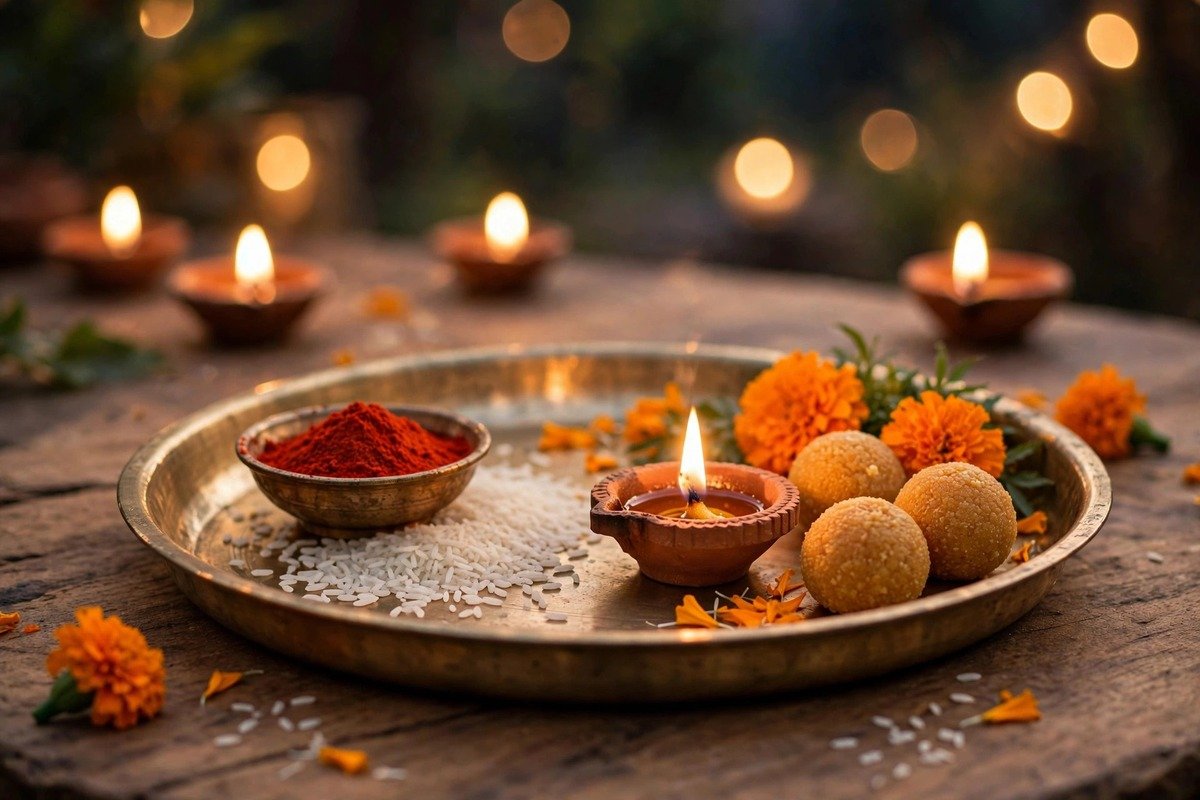
The puja vidhi of Bhai Dooj is simple, yet it is considered deeply sacred. On this day, the sister first takes a bath, wears clean clothes and prepares the tilak thali. The thali carries roli or kumkum, akshat or rice grains, a lit diya, flowers and sweets. In many homes, coconut and fruits are also placed in the thali.
At the auspicious time, the brother is seated on an aasan. The sister first washes his hands and feet, then applies a tilak of roli or kumkum on his forehead. After the tilak, akshat is offered and the brother’s aarti is performed. The sister then prays for her brother’s good health, happiness and success, and feeds him sweets. The brother, in turn, gives his sister a gift or dakshina, wishes her a happy life and lovingly partakes of the food cooked by her hands.
Tradition holds that eating food cooked by the sister’s hands increases the brother’s lifespan and removes the troubles of life. Married sisters invite their brothers to their marital homes, while unmarried sisters welcome their brothers at their father’s home. Those who do not have a sister by birth can observe the festival by receiving a tilak from a muhboli, or adopted, sister.
The Auspicious Mantra and the Prayer for Long Life
While applying the tilak on Bhai Dooj, a traditional auspicious mantra is recited. The mantra gives words to the wish for the brother’s long life. It goes: Ganga puje Yamuna ko, Yami puje Yamraj ko, Subhadra puje Krishna ko, Ganga Yamuna neer bahe, mere bhai ki aayu badhe. In this mantra, the prayer is that just as the waters of the Ganga and Yamuna flow on without end, the brother’s life too should keep growing longer.
Along with this, sisters pray on this day that their brother should live as long as Markandeya, Hanuman, Bali, Parshuram, Vyas, Kripacharya, Vibhishan and Dronacharya — all names that stand in Indian tradition as symbols of long life and immortality. Behind this prayer lies the feeling that the brother’s life should be long, healthy and full of honour.
Different Names and Traditions Across India
Bhai Dooj is celebrated under different names in different regions of India, but the feeling remains the same everywhere. In West Bengal it is called Bhai Phonta, where sisters observe a fast and apply tilak to their brothers with the chanting of mantras. In Nepal it is known as Bhai Tika, and in Maharashtra as Bhau Beej. In North India, the names Bhaiya Dooj and Yam Dwitiya are more common.
Regional customs may differ — at some places a square of rice flour is drawn before the tilak, at others the sister ties a kalava on the brother’s wrist, and at yet others special dishes are prepared. But the centre of every tradition is the same: the sister’s prayer for her brother’s well-being and the brother’s promise of affection and protection. This very diversity makes the festival a festival of the whole country.
How Bhai Dooj Differs from Raksha Bandhan
People often compare Bhai Dooj with Raksha Bandhan, but the feeling of the two festivals is different. In Raksha Bandhan, the sister ties a rakhi on her brother’s wrist and takes from him a promise of protection, while in Bhai Dooj, the sister applies a tilak on her brother’s forehead and prays for his long life and well-being. Raksha Bandhan falls in the month of Shravan, while Bhai Dooj comes in Kartik, after Diwali.
Another difference is that in Bhai Dooj, the brother’s visit to his sister’s home is considered particularly important, because in the story too, Yamraj himself visited Yamuna’s home. That is why, on this day, the brother visiting his sister’s home, receiving her tilak and sharing her food is considered the most auspicious way of observing the festival.
Gifts, Food and the Family Gathering
A beautiful aspect of Bhai Dooj is the exchange of gifts and food. After the tilak, the brother gives his sister a gift. The gift need not be expensive — in tradition, it is not the price of the gift that matters but the affection behind it. In many families, the brother gives his sister clothes, jewellery or something of her choice, while in others, dakshina and blessings alone are considered enough.
Food is also an important part of this festival. The sister cooks her brother’s favourite dishes with her own hands. It is believed that partaking of the food cooked by the sister’s hands is itself the greatest blessing of this festival. In many homes, special sweets, puri-sabzi and kheer are prepared on this day. The whole family sits together for the meal, which strengthens family bonds further.
In today’s times, when brothers and sisters live in different cities, the festival has still kept its place. Brothers who cannot reach their sister’s home receive the tilak over a video call and send gifts online. The medium may have changed, but the feeling remains the same — the sister’s prayer for her brother’s well-being and the brother’s affection.
What Lies Ahead
With Bhai Dooj, the festival of lights comes to an end, and attention turns to the next important dates of the Kartik month. Within a few days of Bhai Dooj, preparations for the Chhath Mahaparv begin, followed by festivals like Dev Uthani Ekadashi and Tulsi Vivah. But the lesson of Bhai Dooj stays with us through the year — that giving time to relationships, honouring a sister’s prayer for her brother’s well-being and keeping family bonds strong is the true message of this festival.
This year, on 11 November, when sisters apply tilak to their brothers, behind it will stand the same old story of Yamraj and Yamuna, which has kept the affection between brother and sister alive for generations. That small mark of tilak is not merely the colour of roli, but a symbol of a sister’s prayer and her unbroken love for her brother.
Disclaimer: This story has been prepared on the basis of available sources and verification. If any fact is found incorrect, a correction will be published.