



New Delhi Bureau
Summary: Prime Minister Narendra Modi assured farmers in drought-hit Maharashtra on 3 November 2026 that the Central government will extend all possible assistance, saying the government stands with them with full sensitivity in this difficult time and that no farmer needs to worry. The assurance came as the Maharashtra government sought about Rs 31,000 crore from the Centre for crop-loss compensation, while an interim advance of Rs 5,000 per farmer has already begun reaching farmers in drought-declared tehsils ahead of Diwali.
What the Prime Minister said
Addressing a programme for Pune Metro projects through video conferencing, Prime Minister Modi raised the drought issue directly. He said he was aware of the drought situation in Maharashtra and that the state government had already provided advance assistance. He assured every farmer in Maharashtra that during this difficult time, the government stands with them with full sensitivity.
“Do not worry, we are all standing with our farmers,” the Prime Minister said, adding, “We will collectively face this crisis.” He appealed to people across the country to remember farmers during the ongoing festive season and to ensure that families affected by drought also experience the happiness of Diwali. He said it was a shared social responsibility not to forget the difficulties faced by drought-affected citizens, farmers, and people living in villages.
The Prime Minister said farmers play a significant role in India’s journey towards becoming a developed nation, and that his government is continuously working to empower them. He also noted that under Chief Minister Devendra Fadnavis, the state government had undertaken substantial water conservation work in recent years, but the current natural calamity has created serious challenges.
How widespread is the drought
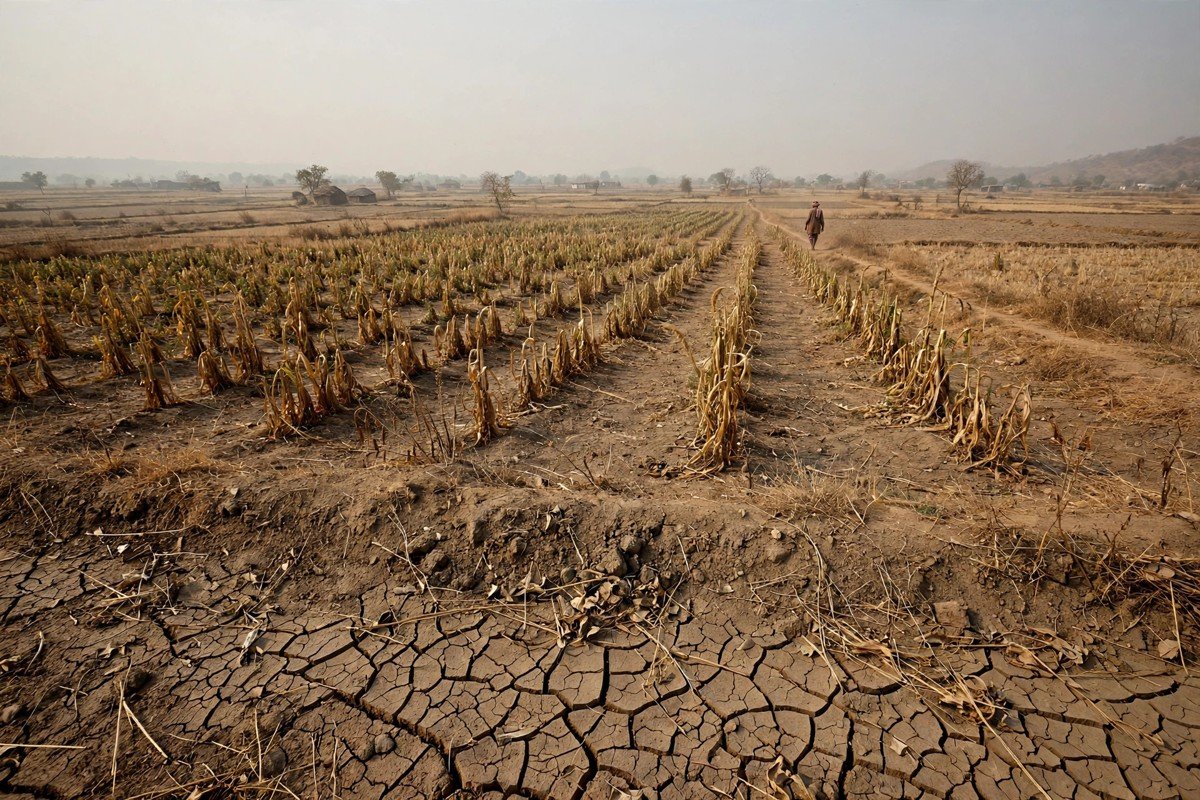
According to the state government’s assessment, the drought is widespread. Of the state’s 358 tehsils, 304 have been declared drought-hit. That figure works out to about 85 per cent, which is the proportion cited across reports of the announcement. Crop-loss assessment has been completed in 37,496 villages across these 304 tehsils.
The assessment found that of 166 lakh hectares of cultivable land in these villages, kharif crops suffered losses of more than 33 per cent on 141.5 lakh hectares. That 33 per cent threshold is the benchmark on the basis of which farmers are treated as eligible for financial assistance. The scale of this loss is the foundation of the state’s demand for central assistance. Low rainfall during the kharif season has hit Maharashtra’s farm economy hard, and it has also weakened farmers’ capacity to repay loans.
The drought is therefore not confined to a few districts. It covers a large part of the state, and the relief demand is correspondingly large. The state government has said the amount sought from the Centre was worked out after assessing ground conditions and the impact on farming.
The Rs 31,000 crore demand and the Rs 5,000 advance
To compensate farmers for crop losses, the Maharashtra government has sought about Rs 31,000 crore in financial assistance from the Centre. The state has also said that separate additional funds will be sought for preparations for the upcoming rabi season. Kharif compensation and rabi preparation are thus being treated as two distinct stages of support.
As immediate relief, the state government has begun sending an advance of Rs 5,000 to farmers in the 304 drought-declared tehsils. The state cabinet had approved advance payments to about 1.5 crore farmers for this purpose. This advance is not the full compensation. It is initial, immediate help, while the remaining compensation will follow on the basis of survey findings and the applicable norms.
In his address, the Prime Minister referred to the advance assistance provided by the state government and assured farmers of all possible help from the Centre. No final decision by the Centre on the Rs 31,000 crore demand has been announced so far. This report therefore does not claim central approval. It records only that the state has made the demand and that the Prime Minister has assured support.
What compensation rates have been reported
According to reports, farmers whose crops suffered losses of 33 per cent or more are eligible for financial assistance under the government norms. The reported rates are Rs 8,500 per hectare for rain-fed crops, Rs 17,000 per hectare for crops with assured irrigation, and Rs 22,500 per hectare for perennial orchard crops.
These rates have been reported as the applicable relief norms. How much any individual farmer actually receives will depend on the category of the area, the type of crop, and the assessed loss. The rates should therefore not be read as a fixed amount payable to every farmer. It has also been made clear that the Rs 5,000 advance is separate from these rates and is being paid as immediate help.
For farmers, the distinction between the advance and the final compensation matters. The advance is meant to help with immediate needs around Diwali, while the final compensation will be determined after a detailed assessment of crop loss.
PM-KISAN and water conservation
The Prime Minister also referred in his address to the assistance being provided through the PM-KISAN scheme, saying he had transferred PM-KISAN funds. This report does not claim a fresh instalment date or amount, since no such detail has been independently confirmed for this report. It records only that the Prime Minister mentioned the scheme in his speech.
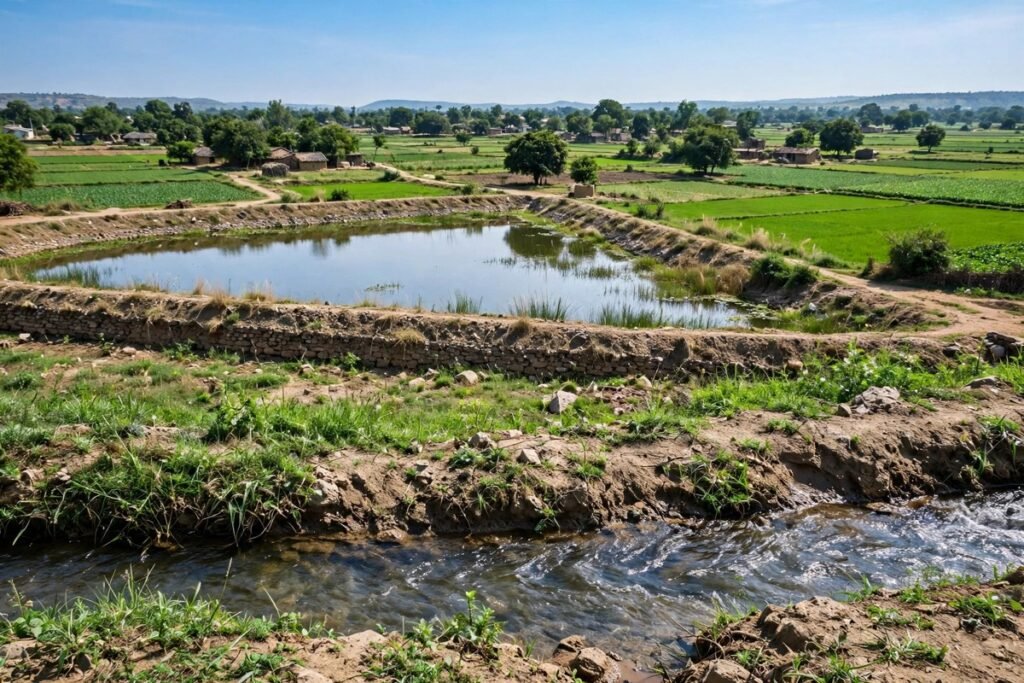
On water conservation, the Prime Minister said the state government under Chief Minister Devendra Fadnavis had done a great deal of work in recent years. Even so, he said, the present natural disaster has created major challenges. The point matters because water conservation structures shape drought resilience over the long term, while a single season of low rainfall immediately increases the demand for relief.
The Prime Minister also said that investments in infrastructure, including roads, railways, airports and metro networks, as well as electricity, drinking water and gas pipeline projects, are improving people’s lives and creating employment. He said houses, toilets, tap water and LPG connections for poor families have boosted their confidence, saved time, and created opportunities for additional income.
The poverty claim: what the Prime Minister cited
Citing a recent World Bank report, the Prime Minister said around 50 crore people had overcome extreme poverty in India within the last 10 to 12 years. He said India is now among the fastest-growing economies and among the fastest poverty-reducing countries. This claim is reported here as the Prime Minister’s statement citing that report.
He said economic growth and poverty reduction are interconnected, and that poverty reduction strengthens the economy by expanding the middle class and increasing purchasing power. He said collective efforts are the lifeblood of the journey towards a developed India. This report does not independently verify the details of the cited report. The Prime Minister’s remarks are presented as his statements, so that readers can clearly distinguish a statement from an independently verified fact.
Background: the metro programme
The Prime Minister made these remarks during the Pune Metro programme, at which Pune Metro Line 3, known as the Pink Line, was inaugurated and foundation stones were laid for four new corridors under Phase-II. The projects together are worth around Rs 21,800 crore. The Pink Line is about 23 km long, built at a cost of over Rs 8,300 crore, and connects the Hinjawadi IT hub with Shivajinagar. Phase-II, estimated at around Rs 13,500 crore, comprises four corridors.
The Prime Minister said India’s operational metro network, which covered 248 km before 2014, now covers around 1,200 km. The metro projects have been covered in detail in an earlier report, so this report focuses on the drought and farm relief rather than repeating the metro details.
What happens next
Attention now turns to the Centre’s decision. The state has sought about Rs 31,000 crore, but no final announcement from the Centre has come yet. A separate demand for rabi-season assistance is also to follow, according to the state government. Meanwhile, the process of sending the Rs 5,000 advance to farmers in drought-declared tehsils is under way.
The coming days matter for farmers because immediate help around Diwali and preparation for rabi sowing are proceeding at the same time. The Prime Minister’s assurance has sent a message that the government stands with farmers in this crisis, but the real test of relief will be how quickly assistance reaches farmers and how many of them it covers.
For Maharashtra’s farmers, this is not only a question of one season. Compensation for kharif losses, preparation for rabi sowing, and the pressure of loan instalments all stand together. The assurance from the Prime Minister marks the government’s stated intent. What follows in terms of decisions and disbursement will determine how much relief actually reaches the fields.
Disclaimer: This news has been prepared on the basis of available sources and verification. If any fact is found to be incorrect, a correction will be published.