





Summary: India has set a target of taking its total exports of goods and services to 1 trillion dollars in the current financial year. Commerce and Industry Minister Piyush Goyal said in New Delhi that exports grew 14 per cent to 480 billion dollars during April–September 2026, leaving 520 billion dollars to be achieved in the remaining six months. He also made it clear that India will not open its dairy sector in any trade agreement and will not allow imports of genetically modified products.
Addressing students at the Young Leaders Discourse Forum at Kirori Mal College in New Delhi, Commerce and Industry Minister Piyush Goyal spoke in detail about India’s trade achievements, its future targets and its clear priorities in trade negotiations. His message was twofold — an ambitious economic target on one hand, and the protection of farmers, fishermen and small enterprises on the other. He told the students that the goal of a developed India by 2047 is non-negotiable, and that today’s students, who will be in their forties when India completes 100 years of Independence, will play a decisive role in shaping the country’s future.
What was said: the 1 trillion dollar target
The minister said India has set an export target of 1 trillion dollars for goods and services in the current financial year 2026-27. This is about 16 per cent higher than last year’s highest-ever exports of 863 billion dollars. He noted that the early outlook for global trade was weak, yet India deliberately chose a higher target. The International Monetary Fund had projected global trade growth of only 1.9 per cent in April–May 2026, but later revised it to around 3.5 per cent. The minister said India’s export performance could have been one of the factors behind that revision.
He also explained that India could have set a target of 900 billion dollars, which would have meant about 5 per cent growth over the previous year and would itself have been more than twice the projected global trade growth. But the government chose to go further and set a 1 trillion dollar target, keeping in view the country’s capacity and global demand. This is not merely a claim about numbers; it is a policy stance — India no longer wants to be satisfied with a small role in world trade and wants to establish itself as a major trading power.
What the six-month figures show
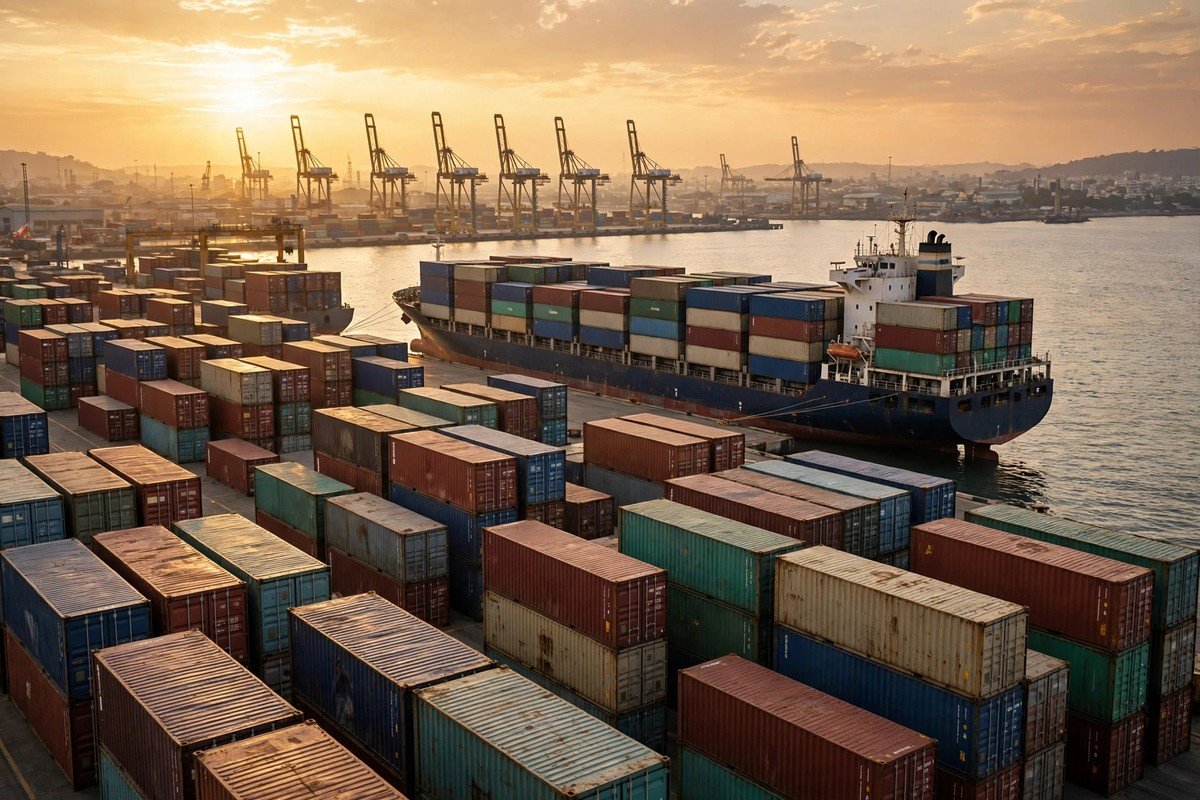
Between April and September 2026, India’s exports reached 480 billion dollars, about 14 per cent higher than the same period last year. That means almost half of the annual target was achieved in the first six months of the financial year. Another 520 billion dollars will have to be exported in the remaining six months, which is somewhat more than the first-half figure, but the minister expressed confidence that the gap can be bridged.
He also said October had been a good month for exports, although the official figures for October will be released in mid-November. It would therefore be premature to give any final figure for October. However, looking at the pace of the first half and the early signals from October, the government believes the target is on the right track. It is important to note that the 480 billion dollar figure covers total exports of goods and services, not goods alone.

900 billion versus 1 trillion: why the ambitious target
An important part of the minister’s address was about the mindset behind setting targets. He asked students whether they wanted to settle for modest targets or aspire for a better future. His point was that transformation does not come from policies alone, but from a change in the way people think, work and live. That is why the government chose the ambitious 1 trillion dollar target instead of the safer 900 billion dollar figure.
Behind this argument, he cited India’s internal strengths — a talented young population, an average age below 30 years, a democratic system, decisive leadership and the demand for quality goods and services from 140 crore people. He said these factors together are driving India’s growth story. He also referred to a recent World Bank report, according to which around 50 crore Indians have come out of extreme poverty and are working hard to improve their lives.
A clear line on dairy and GM products
On trade negotiations, the minister made India’s position on two sensitive areas completely clear. He said India has never opened its dairy sector under any free trade agreement and will not do so in the future. Similarly, India has never permitted the import of genetically modified products and will continue to maintain this position.
He said the government remains committed to safeguarding the interests of farmers, fishermen and micro, small and medium enterprises while negotiating trade agreements. Referring to the certification of dairy products, he said India ensures that ingredients and manufacturing processes do not hurt religious sentiments. He gave the example of animal-derived rennet used in cheese production, an enzyme traditionally obtained from the stomach lining of young calves. Such sensitivities, he indicated, cannot be ignored in trade talks.
Which sectors will get preferential access
The minister said India is aggressively pursuing preferential market access for its key export sectors. These include textiles, pharmaceuticals, footwear, leather, gems and jewellery, marine products, processed foods and agricultural products. The objective is to secure lower tariffs for Indian goods compared with competing countries such as Indonesia, Malaysia, Vietnam, China and the Philippines, so that Indian exporters gain an edge.
He said India is called the pharmacy of the world because of its strength in pharmaceuticals, which is recognised globally. Textiles, marine products and processed foods are also areas of strong Indian capability. India’s negotiating strategy is two-sided — seeking opportunities in sectors where India is strong, while protecting sensitive sectors. The minister said almost every region in the world is seeking to enter into a trade agreement with India because it is seen as a trusted partner.
Why the world’s trust has grown
The minister said India has earned the trust of the world. He credited the country’s talent, the hard work of its youth, its democratic system and its tradition of helping other countries in times of crisis. During the COVID-19 pandemic, India supplied vaccines to the world while ensuring free vaccination for every Indian. India also stood by other countries through medicines, relief material and rehabilitation assistance during crises, whether they were developed or developing countries.
His point was that the world looks at India’s talent, understands its capabilities and remembers the help India gave in difficult times. That is why India is now regarded as a reliable partner. This trust is not limited to trade agreements; it also strengthens India’s global image and diplomatic standing. He added that India has come a long way from being counted among the fragile five economies and is now one of the fastest-growing large economies in the world.
The message for youth: a developed India by 2047
A large part of the address was devoted to young people. The minister said the goal of a developed India by 2047 has to be achieved, and today’s students will be the architects of that journey. He urged students to continuously reinvent themselves, adapt to changing circumstances and pursue learning throughout their lives. On the role of educational institutions, he said colleges do not merely impart academic knowledge; they also build character, resilience, confidence and a willingness to work hard.
Referring to the National Education Policy, he said students can now change courses, earn credits for their academic work and move from one stream to another. On digital connectivity, he said India has 1.1 billion internet users with access to knowledge and experiences from across the world. This, he said, is a major opportunity for young people to learn, grow and contribute to India’s development. He urged students to maintain discipline, respect institutional traditions and pursue larger goals with confidence and courage.
What lies ahead: October figures and the six-month challenge
Two things will matter in the period ahead. First, the official October export figures to be released in mid-November, which will show how strong the start of the second half has been. Second, achieving 520 billion dollars of exports in the remaining six months, which will require global demand, progress in trade agreements and domestic production capacity to all move in the same direction.
The minister also spoke about self-reliance. He said that if supplies of tunnel boring machines are affected, India would explore domestic manufacturing options, as it did when access to rare earth materials was restricted. In addition, engagement with aircraft manufacturers is being increased to support the expansion of the aviation and tourism sectors. Promoting domestic manufacturing and creating avenues for regular employment are also government priorities, and students were encouraged to explore entrepreneurship and startup opportunities.
Overall, the message delivered in New Delhi presents a picture of a balanced trade policy — aggressive access to global markets, firm protection of sensitive domestic sectors, and a long-term vision of development built on young people. The 1 trillion dollar target is certainly ambitious, but the first-half figures show that it rests on solid progress, not merely on paper. All eyes will now be on the October figures in mid-November and on performance in the remaining six months.
Disclaimer: This news has been prepared on the basis of available sources and verification. If any fact is found incorrect, a correction will be published.