









Ujjain Bureau
The Madhya Pradesh government has unveiled its most ambitious preparation plan ever for Simhastha-2028, the Kumbh-scale religious congregation held every 12 years on the banks of the Shipra river in Ujjain. According to the government’s September-2026 report, more than 40 crore pilgrims are expected this time — nearly seven times the 6-crore turnout of the 2016 Simhastha. To handle this unprecedented crowd, over 225 development works worth more than ₹25,000 crore are underway across different districts, while temporary fair infrastructure worth about ₹3,000 crore has been proposed for the mela area itself.
The 40-crore estimate — the scale of the challenge
Simhastha is one of India’s four Kumbh gatherings, and Ujjain’s edition in 2028 is expected to dwarf all previous records. According to the government report, the mela area will span 3,219 hectares with 30 parking sectors. Daily parking capacity is proposed at 10.13 lakh vehicles on normal days and 22.35 lakh vehicles on parva-snan (auspicious bathing) days. The target bathing capacity at the ghats is 4 crore pilgrims in a single day — a figure that captures the sheer scale at which the administration is planning.
A web of roads — redrawing Malwa’s connectivity map
The largest share of the investment is going into roads. The Indore-Ujjain six-lane road (46.475 km, ₹1,692 crore) is 97.54% complete and targeted for completion by November 2026. At a review meeting on October 19, Chief Minister Mohan Yadav fixed an October 2027 deadline for 175 works worth ₹20,000 crore, and this six-lane highway is a key part of it.
Beyond it, the Ujjain-Indore greenfield road (₹2,935 crore), Ujjain-Jaora four-lane (₹5,017 crore), Ujjain-Jhalawar widening from two to four lanes (₹2,523 crore), and the Ujjain-Garoth road (₹2,660 crore) are all under construction. According to the government report, these roads will permanently strengthen Malwa’s backbone — the investment is not limited to the fair but is being converted into lasting infrastructure.
Cleaning the Shipra — the ₹919-crore Kanh diversion bet
The biggest recurring challenge of every Simhastha has been the cleanliness of the Shipra. This time the government has placed a special focus on it. The Kanh diversion project, worth ₹919 crore, aims to stop the polluted water of the Kanh river from mixing with the Shipra. In addition, ₹614.53 crore is proposed for water storage at Sevarkhedi-Silarkhedi so that the Shipra carries adequate clean water round the year.
Experts note that low water flow in the Shipra has been a chronic problem at every Simhastha. This storage project is the biggest effort yet to fix it. The government claims these projects will keep the Shipra’s water clean and bath-worthy — a claim that will stand proven only when construction finishes on time and water quality is monitored continuously.
Expanding the ghats — a 4-crore daily bathing target
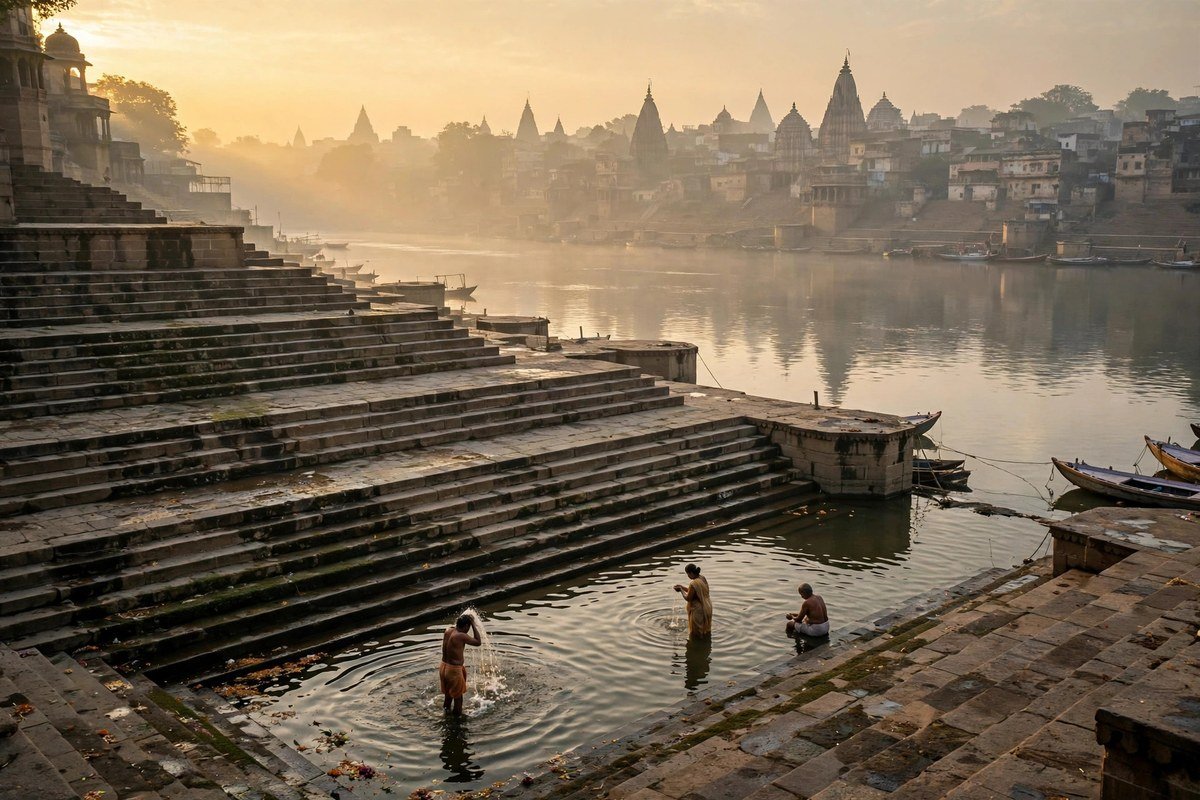
More than 29 km of new ghats are being built on the Shipra at a proposed cost of ₹778 crore, while 7.8 km of existing ghats will be upgraded for ₹120 crore. The target is a daily bathing capacity of 4 crore pilgrims — several times higher than in 2016.
The ghats are being designed for easy crowd management, with special facilities for women, senior citizens and persons with disabilities, and clear evacuation routes for emergencies. According to the government report, changing rooms, drinking water, medical aid and security posts are also part of the plan.
Rail and road transport — 236 special trains, 2,000 buses
The transport plan is equally large. According to the proposal, 236 special trains will run, 7 stations will be upgraded, and 2,000 buses will ferry pilgrims to the ghats. Shuttle buses will move devotees from the 30 parking sectors to the mela area.
To manage such volumes, smart traffic systems, drone surveillance and digital information boards have also been proposed. The strategy on both rail and road is clear: control the crowds before they enter the city.
Not just Ujjain — the whole of Malwa in the plan
The most distinctive feature this time is that the plan is not limited to Ujjain. Roads, transport, drinking water, sewerage and religious sites are being developed towards Indore, Jaora, Jhalawar, Garoth and Maksi. Simhastha is being turned into an opportunity for the integrated development of Malwa.
Better connectivity from Indore to Ujjain, an expanded religious-tourism circuit and upgraded basic amenities in rural areas — all of this is happening in the name of Simhastha, but the benefits will outlast the fair. The government’s argument is that such investment will also energise the regional economy, as better roads and facilities boost both trade and tourism.
The October 2027 deadline — and the road ahead
Chief Minister Mohan Yadav has set October 2027 as the deadline for 175 works worth ₹20,000 crore — roughly six months before Simhastha, leaving time for trials, corrections and final preparations.
Still, completing works of this scale on time is always a challenge. Monsoon, land acquisition and contractor capacity can all affect the timeline. The government says monthly reviews are underway and no delay will be tolerated. The success of Simhastha-2028 now hinges on whether these big numbers on paper translate into reality on the ground, on time.
Disclaimer: This report has been prepared on the basis of available sources and verification. Corrections will be published in case of any factual error.