






Ujjain Bureau
A scientific investigation by IIT Indore has found severe Kshipra river pollution in a drain that flows directly into the river — the same river in which an estimated 30 crore pilgrims are expected to take the holy dip at Ujjain during Simhastha 2028. At its worst point, the drain carried a waste load more than 200 times the national limit for bathing water, with almost no oxygen left in the water, faecal bacteria beyond the highest level the tests could measure, and seven heavy metals.
With Simhastha now less than a year and a half away, the findings land at a sensitive moment. The state government has already announced a ₹1,211-crore package of development works for Ujjain and issued an appeal to devotees ahead of the pilgrimage. The IIT report asks a harder question: will the water the pilgrims step into be safe?
Kshipra river pollution: what the IIT Indore study found
Professors Kiran Bala and Manish Kumar Goyal of IIT Indore collected water from three points on Nagdhaman Nala, a drain in Dewas, in August this year, according to the report. What they found was pollution at every point they tested, and of a kind that leaves little room for doubt.
A river needs oxygen to stay alive. Healthy river water holds more than five units of dissolved oxygen. At one of the three testing points, the water held almost none — far below one unit. At another point, oxygen was close to normal, but the water was still heavily polluted.
The waste load told the same story. The national limit for bathing water is three units of biochemical oxygen demand (BOD). At one point, the drain carried over 200 times that limit. At another, it carried roughly 100 times the limit. A second test, which measures the chemical burden in the water, also showed very high readings at all three points.
The study found seven heavy metals in the water — cadmium, chromium, copper, nickel, zinc, manganese and lead. These metals do not break down in water and can build up in living things. Sewage contamination was found at all three points. Faecal bacteria went beyond the highest level the test could measure, and E. coli was also detected.
The researchers also recorded a foul odour and signs of untreated household and industrial wastewater flowing into the drain. Their verdict was plain: the water is unfit even for direct household or recreational use without treatment. IIT rated the point beside the treatment plant as highly polluted and the other two as severely polluted. The report does not name any company as the source of a particular pollutant.
Where the drain meets the river
Nagdhaman Nala runs through the Dewas industrial area and joins the Kshipra near Hawankhedi village. The Comptroller and Auditor General’s audit on the degradation of the Kshipra documents this confluence and marks a sampling point there, to check the impact of Dewas’s industrial waste and sewage on the river.
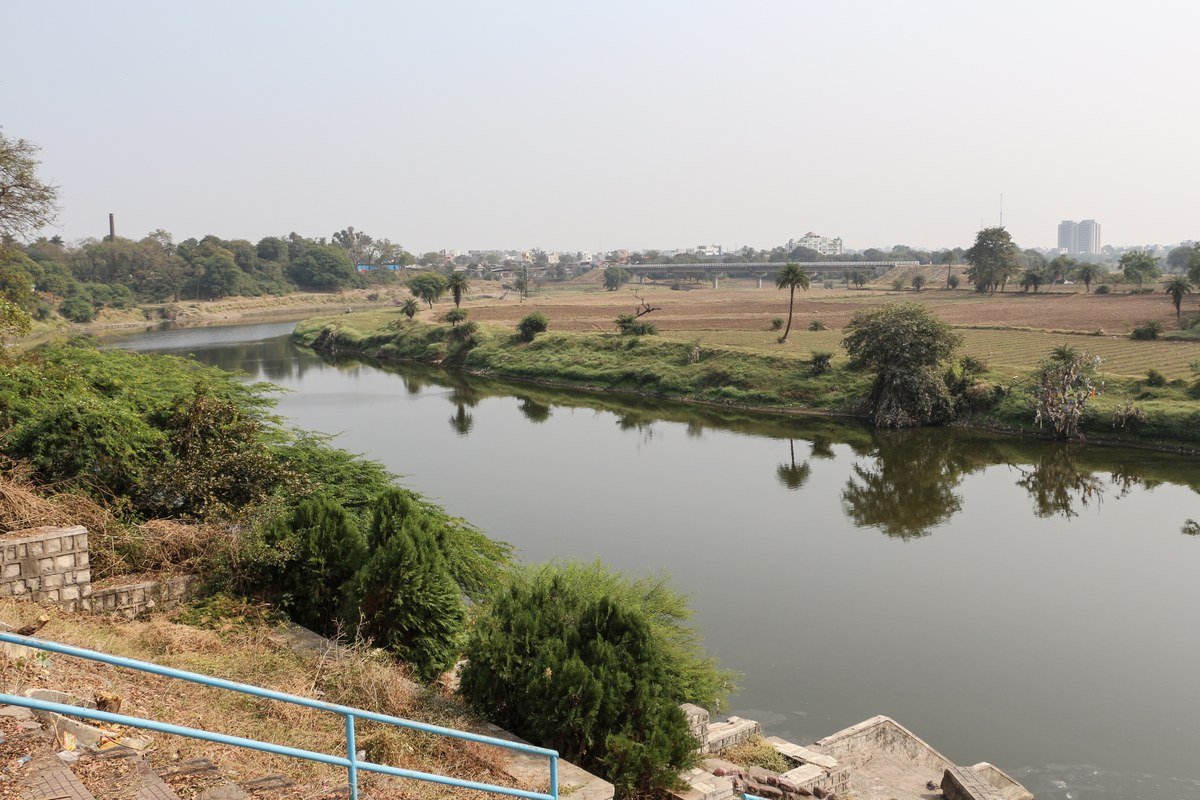
That geography is what turns a local drain into a much larger problem. Officials point out that the IIT study tested the drain, not the river, and does not claim these concentrations have reached the bathing ghats in Ujjain. But whatever the drain carries enters the Kshipra, which flows on towards Ujjain. A drain carrying heavy metals and sewage bacteria into the river cannot be treated as a local Dewas problem.
The drain has been on the National Green Tribunal’s radar for some time. A joint committee report filed in response to NGT orders in a 2023 case on the Kshipra recorded that Nagdhaman Nala meets the river near Hawankhedi, that sewage from colonies upstream of the Dewas industrial area flows into it, and that the city’s sewage treatment plants were not treating the wastewater of its drains.
The official position — and the gap it leaves
The Kshipra river pollution findings cut against the official position on record. Dewas Collector Ritu Raj, citing an investigation by the Madhya Pradesh Pollution Control Board (MPPCB), had said that industrial effluent in the drain was within the permissible limit. IIT Indore found heavy pollution at every point it tested.
The two sets of results cannot be directly compared, and the report itself makes that clear. The MPPCB laboratory report behind the earlier assurance was not present in the documents, and IIT tested water in the drain rather than effluent at individual factory outlets. The difference in sampling methods means the board’s clean chit and the institute’s warning are measuring different things — and neither side’s figures have been reconciled in public.
Meanwhile, a state government department has written to the Additional Chief Secretary of the Environment Department, demanding immediate action to stop industrial waste entering the drain. A copy has gone to the Member Secretary of the MPPCB, the agency responsible for policing industrial discharge. But there is no record yet of any notice to industrial units, inspection of discharge points or fresh sampling by the board. With Simhastha approaching, that gap between a letter and action is the part the report leaves unanswered.
Why Simhastha 2028 raises the stakes
Simhastha is not a distant event. Ujjain expects around 30 crore pilgrims over the course of the 2028 gathering, and the Kshipra is the river they will bathe in. The scale of that gathering is what makes the condition of the river a question of public health, not only of faith.
The pressure on the city’s sewage system is already documented. The joint committee constituted by the NGT reported that Ujjain presently generates approximately 85 million litres per day (MLD) of sewage, which is expected to increase to nearly 350 MLD during Simhastha 2028. Water samples collected from the Kshipra showed BOD levels ranging from 8 to 12 mg/L, against the prescribed bathing-water standard of 3 mg/L. The Central Pollution Control Board has identified the Kshipra as a Priority III polluted river stretch, based on its 2022–2023 assessment.
In August this year, the NGT’s Central Zone Bench in Bhopal directed the Ujjain Municipal Corporation and the Ujjain Collector to ensure that no untreated sewage or wastewater is discharged into any water body or the river Kshipra. The State Pollution Control Board was directed to conduct inspections at 15-day intervals and, wherever violations are found, ensure remedial and punitive action, including calculation and recovery of environmental compensation. Out of 14 drains in and around Ujjain, 11 have reportedly been tapped — but Piliyakhal, Hatkeshwar and Bhairavgarh drains were found to be continuing to discharge untreated or contaminated wastewater into the river.
What the study says must happen now
The IIT report does not stop at diagnosis. It calls for identifying every pollution source, controlling industrial discharge, better sewage management and a structured monitoring and clean-up plan.
In practical terms, that means inspecting and sampling every industrial outlet on the drain separately, checking whether the sewage treatment plant at Sarvodaya Nagar is actually working, and stopping untreated household sewage from entering the drain. It means making Hawankhedi a regular testing point, with samples taken from the river before the confluence, at the confluence, downstream and at Ujjain’s bathing ghats. Testing must be repeated in the summer, and the results made public before and during Simhastha.
Roads, bridges and ghats can be built to a schedule. Clean water cannot be arranged in the final weeks before pilgrims arrive — which is why the Kshipra river pollution documented by IIT Indore is a deadline problem as much as a chemistry problem, and why the report treats monitoring and clean-up as work that has to begin now, not as a finishing touch.
The limits of the findings
The study’s own cautions matter as much as its numbers. The samples were taken in the monsoon, when rain dilutes pollution — so in the dry months, the drain could be worse. The findings relate only to the samples tested, and the study tested the drain, not the river at Ujjain’s ghats. It does not claim that the concentrations found in the drain have reached the bathing areas, and it names no company as the source of any particular pollutant.
That honesty is also what makes the findings hard to dismiss. The report does not overreach, and it leaves the key question open for the authorities to answer with fresh, public testing — at the drain, at the confluence and at the ghats.
The clean-up already under way
Work to clean the rivers feeding the Kshipra is already in progress, though on a different stretch of the problem. In Indore, a ₹416-crore programme under the Namami Gange campaign is building three new sewage treatment plants to clean the Kanh and Saraswati rivers, which carry the city’s untreated waste towards the Kshipra. A separate ₹919-crore closed-duct project aims to stop the Kanh’s polluted water from reaching the Kshipra at all.
In Ujjain itself, a ₹165-crore master plan aims to make the Kshipra clean before Simhastha 2028, recycling wastewater from the Surasa sewage treatment plant through advanced tertiary treatment and supplying it to industry instead of letting it reach the river. The plan includes a 40 lakh litre underground reservoir at Surasa and a 50 lakh litre overhead tank at Vikram Nagar.
But the scale of untreated sewage remains large. Indore generates more than 900 MLD of sewage every day and can treat only about 430 MLD of it, leaving roughly 470 MLD to flow untreated through drains towards the rivers. Ujjain city generates about 85 MLD of sewage a day, and three big drains are still flowing into the Kshipra. The state’s environment worries do not end with water either — air quality in Madhya Pradesh after Diwali has stayed poor in several cities this week.
Whether the new findings on Kshipra river pollution change the pace of that clean-up will be known in the coming weeks — when the pollution control board’s next round of sampling, or its absence, becomes visible. Until then, the drain at Dewas stands as a test of whether Simhastha’s preparations will be judged by the buildings around the river, or by the water in it.
डिस्क्लेमर: यह खबर उपलब्ध स्रोतों और सत्यापन के आधार पर तैयार की गई है। किसी तथ्य में त्रुटि होने पर सुधार प्रकाशित किया जाएगा।