








New Delhi Bureau
Summary: Defence Minister Rajnath Singh spent Diwali with soldiers of the Trishakti Corps at Sherathang in Sikkim, calling the troops the brightest lights of the festival and paying tribute to fallen soldiers at the Sherathang War Memorial near the Nathu La pass on the India-China border.
Rajnath Singh in Sikkim: Diwali at Sherathang
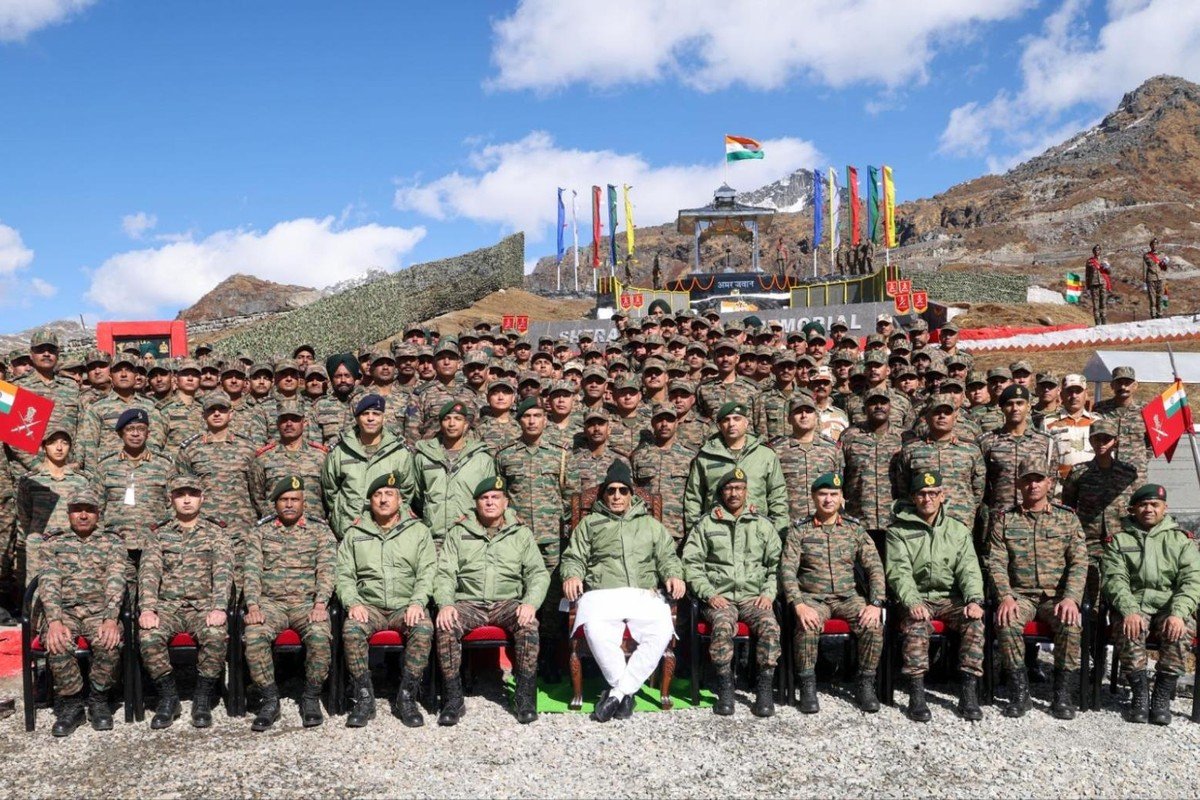
Rajnath Singh in Sikkim spent the festival of Diwali with soldiers deployed in the forward areas of the state, at Sherathang near Nathu La, on 8 November 2026. The Defence Minister celebrated Deepawali with soldiers of the Trishakti Corps, also known as 33 Corps, who guard the high-altitude border in challenging conditions, far from their families.
He was accompanied by the Chief of the Army Staff, General Dhiraj Seth, the General Officer Commanding-in-Chief of the Eastern Command, Lieutenant General VMB Krishnan, the General Officer Commanding of 33 Corps, Lieutenant General Man Raj Singh Mann, and other senior officers of the Indian Army. The Defence Minister’s visit to the forward areas underlined how the festival is marked at the border itself, where soldiers stand watch while the rest of the country celebrates at home.
Sherathang lies close to Nathu La, the mountain pass on the border with Tibet, at roughly 14,140 feet. The area carries the memory of the 1967 Nathu La and Cho La clashes, and the war memorial there honours soldiers who laid down their lives defending the frontier. For the troops posted at such heights, Diwali arrives with snow on the ridges, thin air, and long months away from home — which is why the Defence Minister’s presence on the day itself carried meaning beyond ceremony.
“The brightest lights of Diwali”
Addressing the soldiers at Sherathang, Rajnath Singh described them as the brightest lights of Diwali, saying their dedication and vigilance at the borders give the entire nation a sense of security. “Like a lamp which dispels darkness without seeking attention, soldiers perform their duties silently, ensuring that citizens can celebrate festivals with peace and security,” he said.
He told the troops that their light reaches far beyond the place where they serve. “I am standing here in Sherathang and I feel that all of you are like a single lamp. Your light is not limited to just Sherathang War Memorial. Your light is reaching every house in the country,” he said. Recalling his interaction with the personnel at the high-altitude location, he said the warmth, energy and enthusiasm he received from them were difficult to express in words, and added, “For me, Diwali is the biggest celebration.”
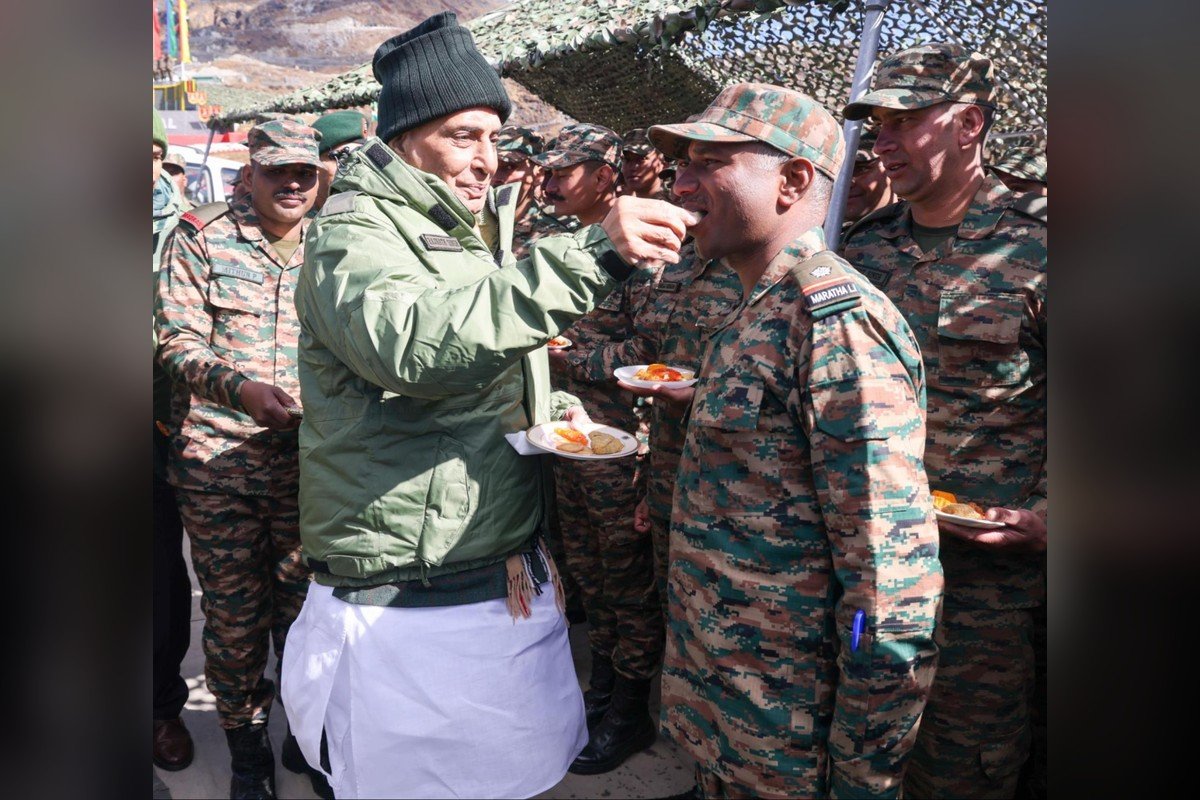
The Defence Minister extended festive greetings to the soldiers and their families. He acknowledged the sacrifices of soldiers who serve far away from their families, placing duty to the nation above self and personal celebrations, and urged them to continue protecting the motherland with the same enthusiasm and dedication. He also shared sweets with the troops, in keeping with the festival.
Discipline before technology
Rajnath Singh in Sikkim used the occasion to underline the importance of discipline and courage in military service. He asserted that no matter how advanced technology may become, it is of little use if a soldier lacks these qualities. “No matter how advanced the technology is, if there is no discipline in the youth, then technology becomes useless in itself. Your discipline is your greatest strength,” he said.
He underlined that the conduct, uniform, language and restraint of the personnel shape the image of the military among local communities. He urged the soldiers to continue strengthening the bond of trust and goodwill shared by the Indian Army and the local population in Sherathang and the surrounding areas, noting that the way soldiers behave with civilians matters as much as the way they guard the border.
Tribute at the Sherathang War Memorial
The Defence Minister paid homage at the Sherathang War Memorial to the soldiers who made the supreme sacrifice in the service of the nation. He laid a wreath at the memorial, where the names of fallen soldiers are inscribed on plaques, and stood before the rock painted with the tricolour and the words honouring the immortal soldier.
Highlighting the significance of the Sherathang War Memorial, Rajnath Singh emphasised that such monuments do more than commemorate past events and sacrifices; they shape collective memory and awaken national consciousness and pride. He stated that the soldiers honoured at the memorial belonged to different parts of the country, including Nagaland, Uttar Pradesh, Tamil Nadu, Rajasthan and Assam. He added that these bravehearts laid down their lives to protect the people, irrespective of their region, language or community.
This spirit of unity and selfless service, he said, is the very soul and ethos of India, where every citizen considers fellow Indians as members of one family. The memorial, in that sense, is not only a record of loss but a reminder that the country’s borders are guarded by soldiers from every corner of the nation.
A visit to the Baba Harbhajan Singh Memorial
Rajnath Singh also visited the Baba Harbhajan Singh Memorial, paying his respects to the revered soldier whose legacy continues to hold a special place in the military and civil traditions of the region. Baba Harbhajan Singh, a soldier of the Indian Army who died near Nathu La in 1968, is remembered with deep reverence by soldiers and civilians alike in Sikkim, and his memorial remains a place of pilgrimage for troops passing through the area.
The visit to the memorial formed part of the same journey of remembrance as the tribute at the Sherathang War Memorial, linking the festival’s celebration with the memory of those who never returned from these mountains.
26,000 names at the National War Memorial
Rajnath Singh emphasised that the Government, under the leadership of Prime Minister Narendra Modi, established the National War Memorial in New Delhi to honour the gallant soldiers who made the supreme sacrifice in the service of the nation. “Approximately 26,000 names of the fallen heroes have been inscribed in golden letters at the National War Memorial to honour their unmatched valour and sacrifice,” he said.
Seeing the name of a fallen soldier at the memorial, he said, evokes a deep sense of pride among their families, relatives and people from their native villages and regions. These memorials, he added, serve as sources of inspiration for the present and future generations, reminding the country that the freedom to celebrate festivals at home rests on sacrifices made far away.
The eve before: Sukna, Bagdogra and the LAC
Rajnath Singh in Sikkim had spent the previous evening in north Bengal. On 7 November, the eve of Diwali, he was in Darjeeling, where he met personnel at the Bagdogra airfield and at Sukna near Siliguri, the headquarters of the Trishakti Corps. During the visit to Sukna, he reviewed the operational preparedness of the Army along the Line of Actual Control in Sikkim, with briefings on border infrastructure, equipment and the use of emerging technologies.
The Sikkim visit continues a tradition the Defence Minister has followed in recent years. In 2024, he celebrated Diwali with soldiers at the Army’s 4 Corps headquarters in Tezpur, Assam. On the same day this year, Prime Minister Narendra Modi celebrated Diwali with security forces in Bastar, Chhattisgarh, while the festival of Diwali was marked by leaders with troops at more than one frontier. For the soldiers at Sherathang, the day ended as it had begun — on duty, in the mountains, with the lamps of the festival lit far below in the plains they guard.
Disclaimer: This news has been prepared on the basis of available sources and verification. If there is any factual error, a correction will be published.