





Desk Report
Chhath Mahaparv 2026 will begin with Nahay Khay on 13 November and conclude with Usha Arghya and Paran on 16 November. During this four-day festival, devotees observe a rigorous nearly 36-hour waterless fast and offer Arghya to the setting and the rising Sun. Here is the full schedule, the rules of the fast, the tradition of the prasad and the significance of the festival.
Celebrated in the Shukla Paksha of the Kartik month, Chhath Mahaparv is regarded as the greatest folk festival of Sun worship. The festival runs for four days and is observed with rules of purity, restraint and a difficult fast. It holds special importance in Bihar, Jharkhand, eastern Uttar Pradesh and the Terai region of Nepal, but in recent years its celebrations can also be seen on riverbanks, ponds and ghats in other cities and metros across the country.
This year, Chhath Mahaparv will be observed from 13 to 16 November 2026. The fast begins with Nahay Khay on the first day, followed by Kharna on the second day, Sandhya Arghya to the setting Sun on the third day, and Usha Arghya to the rising Sun on the fourth day, which marks the end of the fast.
Chhath Mahaparv 2026: The Full Four-Day Calendar
According to the Hindu calendar, the four-day schedule of Chhath Mahaparv 2026 is as follows. The first day, Nahay Khay, falls on Friday, 13 November 2026, on the Chaturthi tithi of Kartik Shukla Paksha. The second day, Kharna, falls on Saturday, 14 November, on the Panchami tithi. The third day, Sandhya Arghya, falls on Sunday, 15 November, on the Shashthi tithi — the main day of the festival. The fourth and final day, Usha Arghya and Paran, falls on Monday, 16 November, on the Saptami tithi.
The Shashthi tithi begins at 11:23 PM on 14 November and lasts until 2:00 AM on 16 November. Based on the Udayatithi rule, the main worship is observed on 15 November. This year, the Shashthi day also coincides with Sarvartha Siddhi Yoga, which will be in effect from 6:44 AM to 11:28 PM on 15 November.
As for the timings of the Arghya, according to the Delhi calendar, sunset on 15 November will be at around 5:27 to 5:28 PM, while sunrise on 16 November will be at around 6:44 AM. Sunrise and sunset timings vary slightly from city to city, so it is advisable to confirm the local timings from the local calendar.
Day One: Nahay Khay — A Pure Beginning
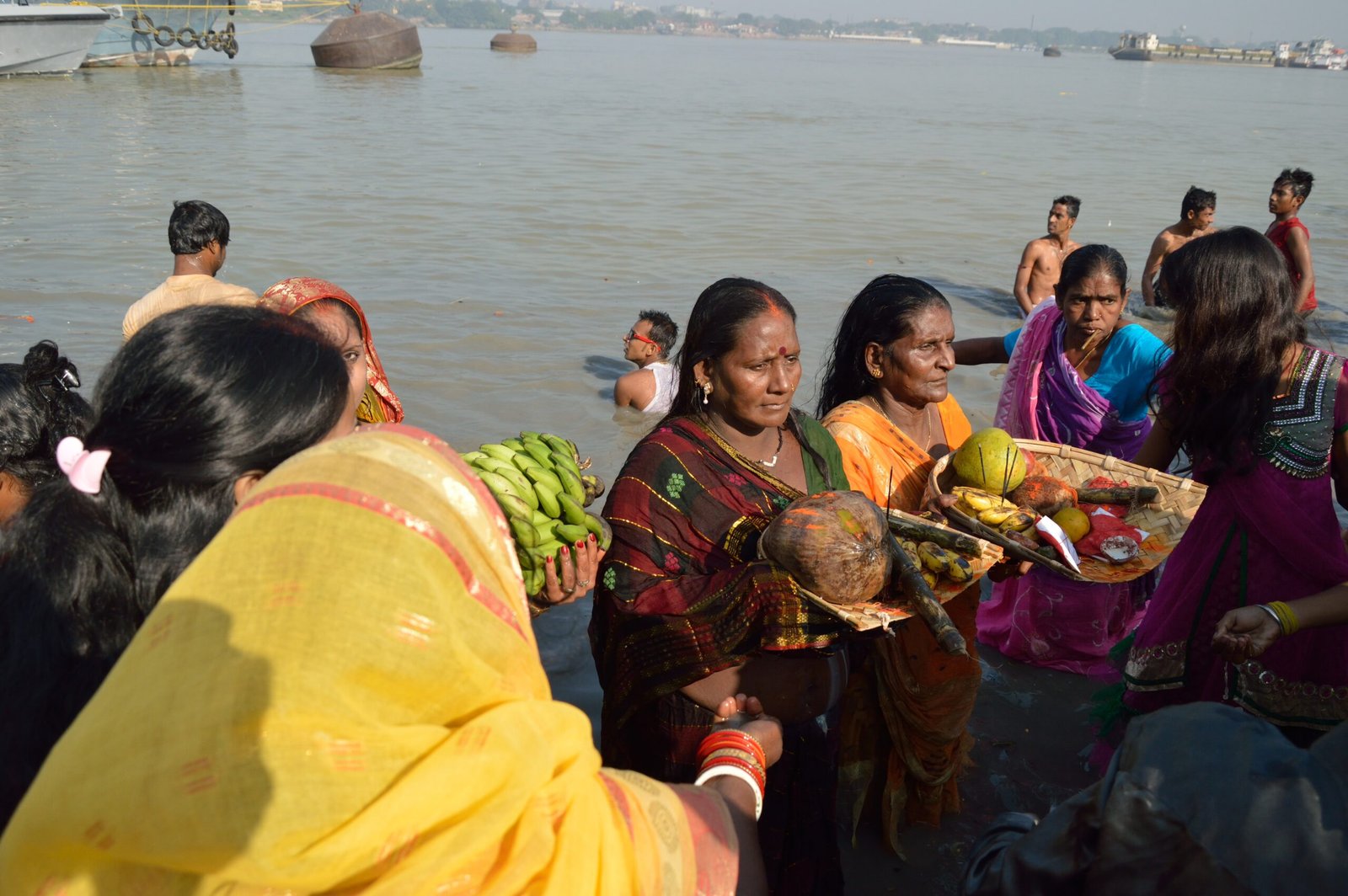
The first day of Chhath Mahaparv is called Nahay Khay. On this day, devotees take a holy bath in a river or another water source, and the home and kitchen are cleaned thoroughly. After this, a simple sattvik meal is eaten. The traditional Nahay Khay meal consists of kaddu-bhaat — bottle gourd curry with rice — along with chana dal.
On this day, the Sun God and the family deities are worshipped and prasad is offered. Nahay Khay marks the beginning of the process of purity of mind and home, which is the preparation for the difficult fast that continues over the next three days. Family members also begin following rules of purity and sattvik living from this day onward.
Day Two: Kharna and the Start of the 36-Hour Waterless Fast
The second day is Kharna. On this day, devotees fast through the day and eat prasad only after the evening worship. The Kharna prasad mainly consists of jaggery kheer, also called Rasiyaw, along with roti.
With the Kharna prasad, the devotee’s nearly 36-hour rigorous Nirjala fast begins. During this period, devotees abstain from both food and water. This is why Chhath is counted among the most difficult fasts. On the evening of Kharna, special worship takes place at home, and family members and neighbours share the prasad.
Day Three: Sandhya Arghya — The First Arghya to the Setting Sun
The most important day of Chhath Mahaparv is the third day, when Sandhya Arghya is offered. On this day, devotees and worshippers gather at rivers, ponds or ghats and offer the first Arghya to the setting Sun. Standing waist-deep in water, devotees offer water to the Sun from a soop or dala basket filled with prasad.
The Sandhya Arghya prasad includes thekua, sugarcane, seasonal fruits, coconut and other traditional preparations. The glow of lamps at the ghats, the sound of folk songs and the crowds of devotees create the most recognisable image of this festival. It is believed that offering Arghya to the setting Sun symbolises gratitude for every phase of life — equal reverence for what is setting as for what is rising.
Day Four: Usha Arghya and Paran — The Conclusion
On the fourth and final day, Usha Arghya is offered in the morning. Devotees reach the ghat before sunrise and offer Arghya to the rising Sun. After this, the fast is broken through Paran, and prasad is distributed. With Usha Arghya, the four-day Mahaparv comes to an end.
After Paran, devotees eat the prasad, and thekua and other prasad items are shared among family, relatives and neighbours. In this way, Chhath also concludes with the tradition of collective joy and sharing prasad with one another.
Significance of Chhath: Worship of the Sun and Chhathi Maiya
Chhath Mahaparv is the festival of worship of the Sun God and Chhathi Maiya. It is believed that this fast fulfils wishes for the well-being of children and brings happiness, prosperity and good fortune to the family. The Sun is regarded as the basis of life — it is from sunlight and energy that crops grow, so expressing gratitude to the Sun is the core spirit of the festival.
One special feature of this festival is that it involves no idol worship; instead, the visible Sun itself is worshipped directly. By worshipping water, soil, the Sun and the season’s new crops — such as sugarcane, wheat for thekua and seasonal fruits — gratitude towards nature is expressed. This is why Chhath is called the greatest festival of folk faith and gratitude towards nature.
Tradition of Chhath: A Difficult Fast, Collective Participation
In the tradition of Chhath, the entire family and community join the devotee. Cleaning the ghat, preparing the prasad, decorating the soop-dala and arranging everything up to the ghat involve all family members. In many places, women are the main devotees, who are called Parvaitin.
Chhath folk songs also hold a special place in the tradition. Sung at the ghats, these songs are regarded as the soul of the festival and have been passed down orally for generations. Despite the rigour of the fast, devotees show deep enthusiasm for this festival, because it is believed that worship performed with true devotion and observance of rules bears fruit.
Rules of the Fast: Purity and Restraint Above All
During the Chhath fast, purity and restraint are given the highest importance. Across all four days, special care is taken of the cleanliness of the home and kitchen, sattvik food and the purity of the prasad. The ingredients used for the prasad are also prepared with sanctity, and rules are followed in touching and serving the prasad.
On the way to the ghat, devotees and family members also take care of cleanliness. Ghats built on riverbanks or beside ponds are cleaned in advance, and lamps and decorations are arranged there. Rest and family support are also considered important for the devotee during the fast, because the 36-hour waterless fast is physically demanding.
The Festive Season Continues
Even after Chhath Mahaparv, the sequence of festivals in the Kartik month will continue. Gopashtami will be observed on 17 November, Akshaya Navami on 18 November, and Devotthan Ekadashi along with Tulsi Vivah on 20 November. After that, Kartik Purnima and Dev Deepawali will fall on 24 November.
The festive season that began with Narak Chaturdashi has passed through Diwali, Govardhan Puja and Bhai Dooj to reach Chhath. In the coming days too, this festive fervour will continue, and the movement of devotees at ghats and temples will go on.
Disclaimer: This report has been prepared on the basis of available sources and verification. If any fact is found to be incorrect, a correction will be published.