




New Delhi Bureau
Summary: Electric passenger vehicle registrations in India rose nearly 75 percent in October 2026 to 36,646, even as the overall passenger vehicle market shrank 14.6 percent to 501,406. The electric share of the market nearly doubled in a year, from 3.6 percent to 7.3 percent, with Tata Motors and Mahindra using their electric growth to cushion a sharp fall in petrol and diesel sales.
October 2026 registration data tells a clear story about change in the Indian car market. Even in a festive month, overall passenger vehicle registrations fell compared with a year earlier, while electric cars surged ahead. Market watchers say the shift looks less like a one-month spike and more like a steady change in what buyers are choosing. At the same time, the numbers need to be read with one caution in mind: Diwali falls on 8 November this year, whereas last year it fell in October, so part of last year’s festive buying may simply have moved into November this year.
October in numbers
According to market registration data, total passenger vehicle registrations in October 2026 stood at 501,406, down 14.6 percent from 587,103 in October 2025. Electric passenger vehicle registrations rose 74.7 percent, from 20,979 to 36,646. Registrations of petrol and diesel vehicles fell 17.9 percent to 464,760. As a result, the electric share of the passenger vehicle market nearly doubled, from 3.6 percent a year earlier to 7.3 percent.
The figure matters because it is not an isolated month. Registration data from the government’s Vahan portal shows electric passenger vehicle registrations rising from 21,029 in January 2026 to 35,777 in October, after peaking at 37,284 in September. Different agencies report slightly different totals because they use snapshots taken on different dates and with different coverage. The headline trend, however, points in the same direction across datasets, and that trend is upward.
How Tata and Mahindra cushioned the fall
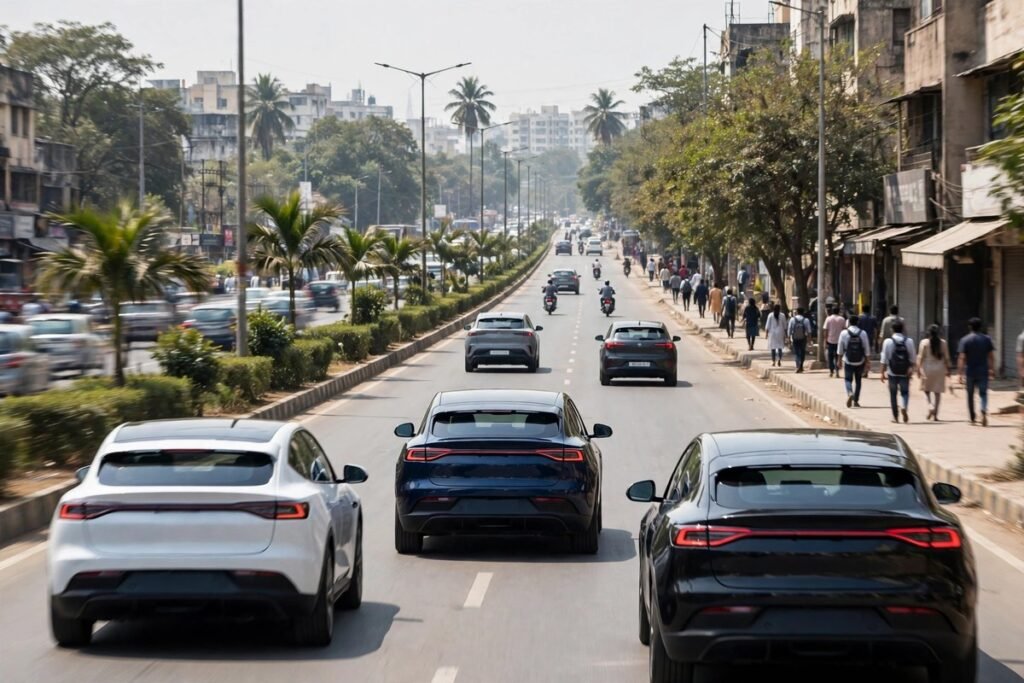
The October story is led by Tata Motors and Mahindra. Tata Motors’ electric registrations rose 76.3 percent to 14,560, up from 8,259 a year earlier. Electric cars now make up 20.2 percent of Tata’s total registrations, up from 10.4 percent, which means roughly one in every five Tata cars registered in October was electric. Tata’s petrol and diesel registrations fell 18.7 percent to 57,693, and its total registrations fell 8.8 percent to 72,253. Without the electric growth, the decline would have been far deeper.
Mahindra’s pattern is similar. Its electric registrations jumped 84.2 percent to 8,473, up from 4,599 a year earlier. The electric share of Mahindra’s total registrations rose from 6.3 percent to 13.2 percent, or about one in eight vehicles. Mahindra’s petrol and diesel registrations fell 19.1 percent, and its total registrations fell 12.6 percent to 64,063. Analysts tracking the data say electric volumes helped both companies soften a much sharper fall in conventional vehicles.
Tata Motors Passenger Vehicles has also said its Punch.ev became the first standalone electric model in its portfolio to cross 5,000 registrations in a single month in October. The company has said demand for its electric vehicles continues to exceed supply, and that it is working to scale up production and improve availability. For buyers, that means waiting periods on some popular electric models may persist for now.
Petrol and diesel decline, and the wholesale contrast
The decline was broad-based. Maruti Suzuki’s registrations fell 15.2 percent to 211,529, Hyundai’s fell 16.6 percent to 57,915, and Kia’s fell 13.4 percent to 30,667. In contrast, MG grew 4.3 percent and Nissan grew 23 percent. The uneven results show that the market is not moving as one block: outcomes differ by model line-up, pricing and availability.
Interestingly, wholesale dispatches, meaning vehicles supplied by manufacturers to dealers, moved in the opposite direction. Industry data puts October passenger vehicle wholesale dispatches up 12.4 percent at 528,384. Maruti Suzuki’s domestic wholesales rose 20.5 percent to 212,384, and Tata Motors dispatched 73,894 vehicles, up 20.9 percent. The gap between dispatches and registrations suggests vehicles reached dealer yards in October but will be registered around Diwali in November. That is why market watchers are treating November’s numbers as the real test of festive demand.
Two-wheeler record and the total EV market
The electric story goes well beyond cars. Across all segments, electric vehicle registrations in India crossed 3.5 lakh for the first time in October, at about 3,54,000, compared with 2,45,000 in October 2025 and 3,38,000 in September 2026. Registrations have now stayed above the three-lakh mark for five straight months, which underlines how deep the shift has become.
Electric two-wheelers did most of the heavy lifting, hitting a record 2,24,000 registrations, up from 1,51,000 a year earlier and 2,09,000 in September. Electric passenger vehicles presented a mixed picture: up about 75 percent year on year, but down about 4 percent from September. Because there is usually a lag before all registrations appear on the Vahan dashboard, the final October tally could still rise. Tesla’s sales in India also crossed 1,000 units for the calendar year, with September and October together accounting for more than half of that total.
The ten-month picture: January to October
The first ten months of 2026 confirm the electric momentum. Tata Motors registered 117,547 electric passenger vehicles in the period, followed by Mahindra at 66,945 and MG at 55,016. Together, the three makers account for more than 83 percent of electric passenger vehicle registrations in the period. Vahan-based data puts total electric car registrations from January to October at 287,453, already well above the 176,817 recorded in the whole of 2025. In other words, ten months of 2026 have already beaten the full previous year by a wide margin.
In market-share terms, Tata holds about 40.7 percent of the electric car segment and Mahindra about 23.7 percent, a combined share of about 64.4 percent. The electric car market is therefore still concentrated around a few large makers, but the arrival of new models and new entrants could change that picture in the coming months. More competition should be good news for buyers, bringing more choice on price, range and features.
Why the festival calendar matters
October’s numbers must be read with the calendar shift in mind. Last year, Diwali fell in October; this year it falls on 8 November. A part of last October’s festive buying has therefore shifted into November this year. The gap between booking, delivery and registration widens that shift further. Market analysts have cautioned that November’s numbers will show whether October’s contraction was mostly a calendar effect or a sign of deeper softness in demand.
The same caution applies to electric vehicles. Annual growth in the electric segment is so strong that it stayed positive despite the calendar effect, but the month-on-month dip from September to October shows that even electric demand is not immune to timing. A three- or four-month trend gives a more reliable picture than any single month.
A minister’s expectation: 35-40 percent by 2027?
Meanwhile, Union Road Transport and Highways Minister Nitin Gadkari has said he believes at least 35 to 40 percent of cars sold in India will be fully electric by next year. That is his expectation and belief, not an official target or a confirmed forecast. Against the current share of 7.3 percent, it looks ambitious, but the minister’s argument is that the pace of electric adoption and the flow of new models will keep the momentum going.
Gadkari has also said green hydrogen is the future and that India can become a net exporter of clean hydrogen. He has argued that fossil fuel costs have risen sharply because of conflicts in West Asia and the Russia-Ukraine war, making self-reliance in energy essential. On flex-fuel vehicles, he has said Toyota is working on an Innova Flex-Fuel model for launch this month, compatible with E100 fuel, which is nearly pure ethanol. Maruti Suzuki launched India’s first flex-fuel passenger vehicle earlier this year, the Wagon R Flex Fuel, capable of running on ethanol-petrol blends from E20 to E100. The road transport ministry notified changes to the Central Motor Vehicles Rules last month allowing flex-fuel vehicles that can run on E100.
What it means for buyers
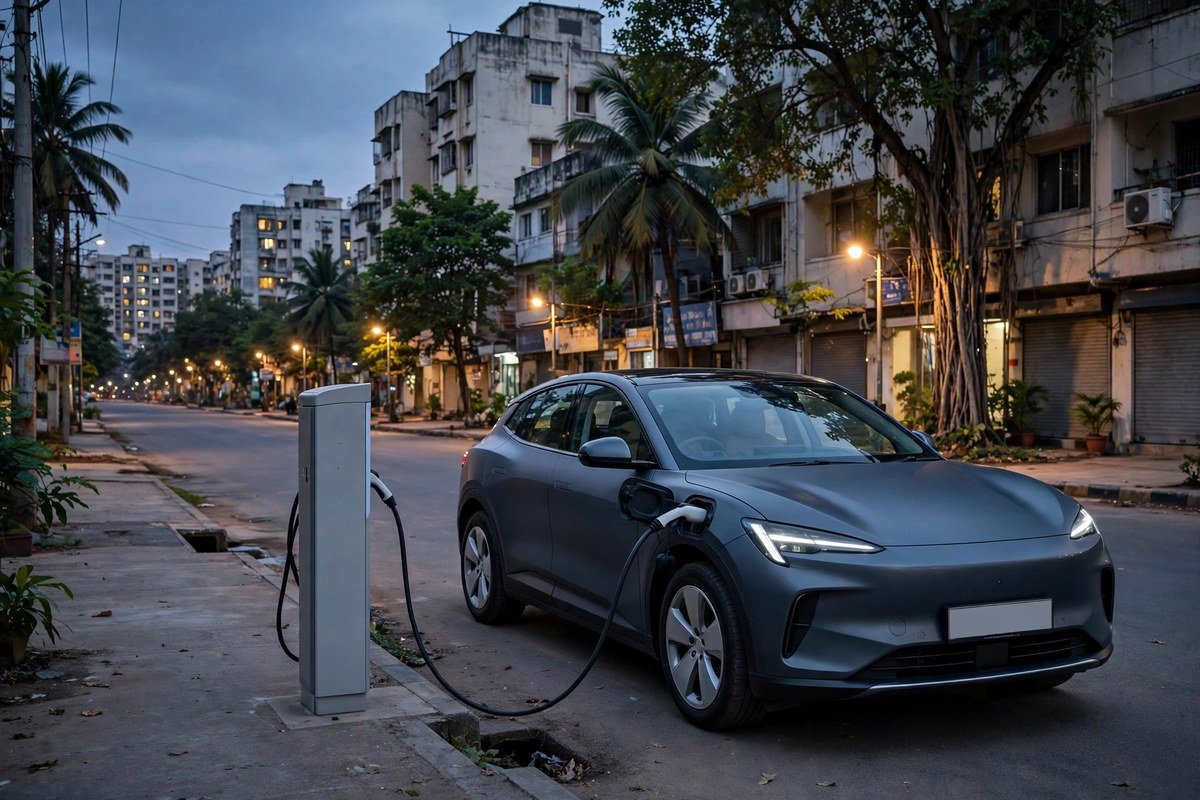
For ordinary buyers, October’s data carries several signals. First, electric choices are expanding fast and their prices are becoming more competitive. Second, charging infrastructure is spreading, although buyers outside big cities still need to check local availability carefully. Third, change is reaching larger vehicles too: electric trucks are beginning to enter commercial fleets, which could affect freight costs and pollution over time, and the luxury electric car segment is also seeing new arrivals.
Before buying, a few checks remain essential. Real-world range, charging access at home or work, the service network and battery warranty terms matter as much as the sticker price. Festive-season discounts and offers can look attractive, but their conditions deserve a careful read. Once November’s numbers arrive, the market picture will sharpen further, showing whether the electric surge gathers more speed with Diwali buying or cools off a little. For now, one thing is settled: the balance of India’s car market is shifting, and electric vehicles are gaining ground month by month.
Disclaimer: This report has been prepared on the basis of available sources and verification. If any fact is found incorrect, a correction will be published.