



Bhopal Bureau
Summary: Bhopal and Indore metro stations have put 4,630 square metres of commercial space up for fresh bidding after no retail space in Bhopal was booked in the past four months. Low passenger footfall and a lack of parking are cited as the main reasons. Online bids for Bhopal’s two stations close on 16 November and will be opened on 17 November.
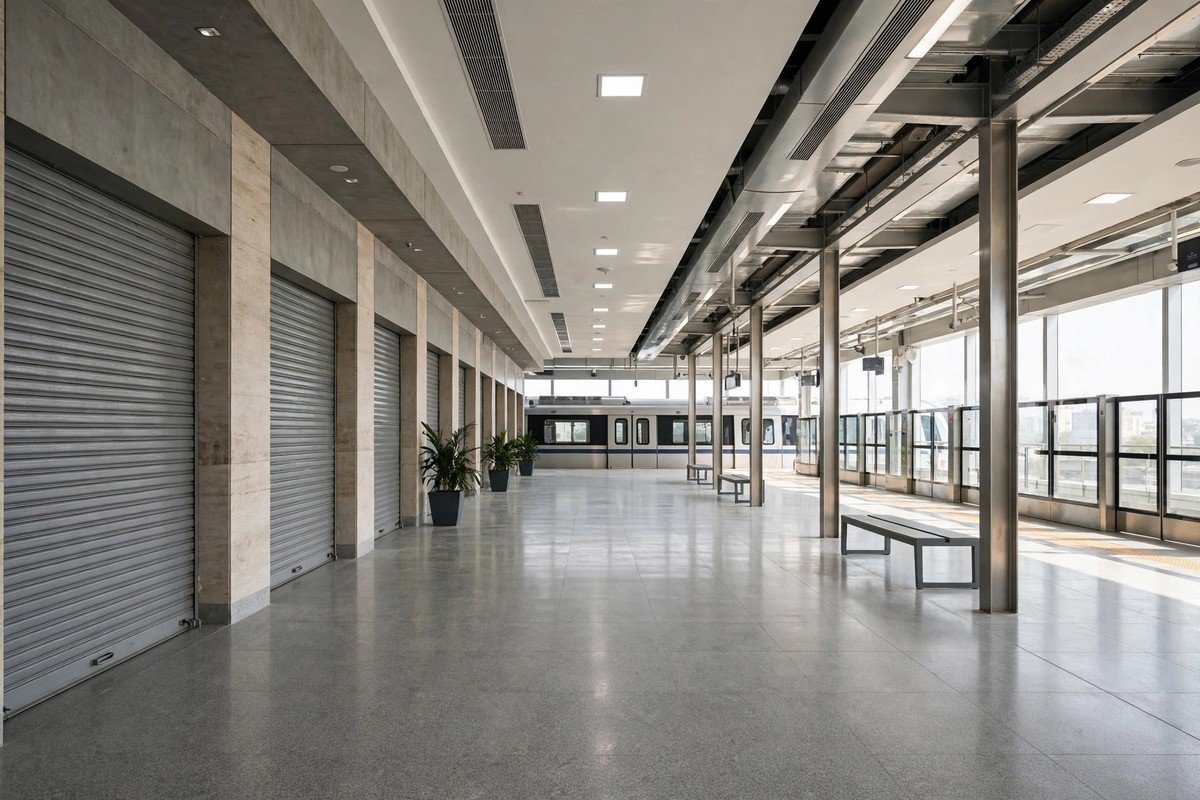
Metro stations in Bhopal and Indore are meant to be more than places to catch a train. The Madhya Pradesh Metro Rail Corporation wants them to become everyday service points, with shops and food outlets inside station premises. To that end, it has identified 4,630 square metres of commercial space across five stations in the two cities. But the plan has run into a difficult market reality. In Bhopal, not a single retail space has been booked in the past four months, forcing the corporation to invite fresh bids. The episode shows that offering space is only part of the challenge. For a shop inside a metro station to work, it needs passengers, access, parking and licence terms that make business sense. All four are now under scrutiny as the new fresh bidding round opens.
Where the space is, and how much
In Bhopal, tenders have been invited for 3,230 square metres across two stations: 710 square metres at Board Office Square station and 2,520 square metres at Subhash Nagar station. In Indore, 1,400 square metres have been earmarked across three stations: ISBT, Hiranagar and Bapat. About 1,050 square metres of the Indore space is at the ISBT station. Online bids for the two Bhopal stations must be submitted by 16 November, and the bids will be opened on 17 November. Tenders for the Indore stations are to be issued shortly. The plan envisages shops and food outlets beginning operations within six months of allotment. Reports linked to the plan also put the employment potential at around 10,000 direct and indirect jobs. That figure is an estimate tied to the full plan, and the actual number will depend on how much space is actually taken up and what kind of businesses open there.
Why the first tender round ended without a deal
The first tender process for Bhopal’s commercial space began in June. Three businesses showed initial interest, but none of them went on to take the space. Since then, no retail space in Bhopal Metro has been booked for four months. The reasons cited are the absence of parking facilities and poor passenger movement. Daily passenger footfall on the metro services has been reported at below 100, a figure that appears in reports as a reported estimate rather than an officially published ridership count. It has to be read in context: the metro networks in both cities are still limited in reach, so stations do not yet draw the crowds that a busy commercial location would. When footfall is low, a retailer cannot be confident of sales. When parking is missing, even the passengers who do come find it harder to stop, shop and leave conveniently. The combination explains why initial interest did not convert into signed deals, and why the corporation has had to go back to the market.

The licence terms bidders must weigh
The tender terms contain several points that any bidder will study closely. Selected firms will get space on a 10-year licence, with a mandatory two-year lock-in. During the lock-in, a firm cannot surrender the premises, even if sales remain poor. After the lock-in, termination will require 180 days’ advance notice, and partial surrender of the space will not be permitted. Firms will get 180 days to set up their outlets, treated as a fitment window. Licence fees will apply after this period, although a firm that starts business earlier may have to pay from the date it begins operations. The licence fee will rise by 5 per cent every year on a compound basis. GST, electricity and water charges will be additional, and firms will bear the cost of construction and development. Only temporary structures will be permitted, and only with the corporation’s approval, and nothing may obstruct passenger movement or station security. These terms give the corporation a stable, long-term tenant, but they also transfer much of the commercial risk to the bidder, which is exactly why footfall and parking matter so much to the outcome.
Board Office and Subhash Nagar: deposits and turnover conditions
The financial conditions differ between Bhopal’s two stations because the spaces differ in size. At Board Office station, the 710 square metres on offer carry an earnest money deposit of Rs 1.20 lakh and a minimum average annual turnover requirement of Rs 86.27 lakh. At Subhash Nagar, the 2,520 square metres carry a deposit of Rs 4.20 lakh and a minimum average annual turnover requirement of Rs 3.13 crore. Both carry a 10-year licence and a two-year lock-in. Bidders will quote a monthly licence fee per square metre, payable in advance every three months. The structure is designed to attract financially sound businesses, but the turnover thresholds may be a hurdle for smaller local traders, while larger brands may treat them as routine. The difference between the two stations also reflects their different commercial potential: the larger Subhash Nagar space demands a larger deposit and a higher turnover, matching the bigger commitment involved.
What passengers could gain if the plan works
If the bidding succeeds, passengers could find a range of everyday facilities inside stations: shops, food outlets, cafes, convenience stores, ATMs and branded showrooms. Earlier plans for the stations have also discussed coaching centres, salons and clinics. The idea is that a commuter should be able to make a small purchase, grab a snack or reach a basic service without leaving the station. Ticket vending machines at Bhopal-Indore metro stations already issue a ticket in 30 seconds. That would improve the travel experience, particularly as the metro networks expand. But the benefit runs both ways. More passengers would make the shops viable, and better facilities at stations could themselves attract more passengers. At present, with limited network coverage, neither side of that equation is strong. The corporation therefore faces a linked challenge: it must grow ridership and make its commercial spaces attractive at the same time, rather than treating the two as separate tasks.
The push to grow non-fare revenue
MP Metro managing director S Krishna Chaitanya has said the corporation is working to increase non-fare revenue. Tenders have also been issued for station naming rights, announcements and advertising. This is a familiar strategy for metro systems worldwide, where fare income alone rarely covers operating costs. Advertising, branding, commercial leasing and other services are meant to bridge the gap and make the system more financially sustainable. Bhopal has already seen station branding and co-branding rights offered for eight stations. Yet the empty retail spaces show that the market response has been slow. The corporation will now have to demonstrate that doing business at a metro station can pay, and that will require progress on ridership, parking and access as much as flexibility in tender terms.
What happens next: the 16-17 November bids
Attention now turns to 16 and 17 November. Online bids for Board Office Square and Subhash Nagar stations close on 16 November and will be opened the next day. The response will show whether this round fares better than the first. Tenders for Indore’s ISBT, Hiranagar and Bapat stations are expected to follow shortly. If Bhopal’s bidding draws a good response, it will be a positive signal for the metro’s commercial plan. If the response is again weak, the corporation may have to revisit its terms, pricing or facilities. For passengers, the timeline also matters: the target of shops and food outlets opening within six months depends on this bidding round succeeding and on allottees setting up within their 180-day fitment window. The coming days will show whether Bhopal’s metro stations finally find their shopkeepers, or whether the shutters stay down a little longer.
Disclaimer: This story has been prepared on the basis of available sources and verification. If any fact is found to be incorrect, a correction will be published.