








Desk Report
Prime Minister Narendra Modi spoke to German Chancellor Friedrich Merz on Tuesday, reviewing the growing momentum in the India-Germany Strategic Partnership and discussing the India-EU FTA ahead of its expected signing in December, along with the Russia-Ukraine war and other global developments.
The telephone conversation, held on 24 November, came at a moment when the long-negotiated trade agreement between India and the European Union is moving towards its final stage. The two leaders agreed to keep working closely together to promote global peace, stability and a rules-based international order, and underlined the importance of cooperation at multilateral forums in addressing contemporary global challenges.
The Call: Partnership, Trade and Technology
During the conversation, Modi and Merz reviewed progress in the India-Germany Strategic Partnership and expressed satisfaction at the sustained momentum in bilateral engagements, the Prime Minister’s Office said in its statement.
The two leaders reaffirmed their commitment to expanding cooperation across key sectors, particularly defence and advanced technologies, and discussed ways to unlock new opportunities in trade and investment between the two countries.
Modi later described the conversation as productive. “Had a productive conversation with Chancellor Friedrich Merz. We reviewed the growing momentum in the India-Germany Strategic Partnership and discussed ways to unlock new opportunities in trade and investment, defence and advanced technologies. India and Germany will also continue to work closely together to address global challenges and promote peace, stability and a rules-based international order,” he said in a post on social media.
India-EU FTA: The ‘Mother of All Deals’
A central thread of the conversation was the proposed India-EU FTA, which the two leaders noted would unlock several new opportunities for expanding bilateral trade and investment.
The agreement, described as the “mother of all deals”, is expected to be signed in December. Negotiations between India and the 27-member European Union were concluded in January this year, at the India-EU summit in New Delhi on 27 January 2026. Reports in the Indian press have said Modi is expected to travel to Brussels to sign the agreement on 16 December.
The European Commission put forward its proposals to the Council for the signature and conclusion of the agreement on 11 September 2026, using a fast-track procedure aimed at speeding up its implementation. Commerce Secretary Rajesh Agrawal said on 18 November that India hopes to sign the agreement in December 2026, and is aiming for it to take effect in the first quarter of 2027.
The European Union’s Ambassador to India, Jean-Eric Paquet, said on Monday that the agreement is expected to be signed in December and could come into force by the middle of 2027, after scrutiny by the European Parliament.
What the Deal Would Change
If it enters into force, the agreement would create the world’s biggest free trade zone, covering nearly two billion people. India and the EU together account for around 25 per cent of global GDP and nearly one-third of international trade, making the proposed agreement significant for both sides. It would be the largest trade deal either partner has ever concluded.
The proposed agreement is expected to provide duty-free access to the EU market for 93 per cent of Indian shipments. India will eliminate or reduce tariffs on 96.6 per cent of EU goods exports, while the EU will do the same for 99.3 per cent of Indian exports, and the European Commission estimates duty savings of about 4 billion euros a year. Goods trade between India and the EU stood at 118 billion euros in 2025.
The deal is also expected to make imports of certain European luxury goods, including cars and wines, cheaper in India, while giving Indian exporters — from textiles and gems to engineering goods and services — far wider access to the European market.
The Road to Signing — and Beyond
Signing the agreement will not be the final step. After signature, it will require a decision by the Council, the consent of the European Parliament, and ratification by India before it can enter into force. The European Parliament’s Foreign Affairs Committee recently visited Delhi to understand the process of scrutiny, and its chair expects the Parliament to form its view in the spring.
Alongside the FTA, India and the EU have also announced a security and defence partnership, a comprehensive framework of cooperation on mobility, and a joint comprehensive strategic agenda. Two further agreements — one on investment protection and one on geographical indications — remain under negotiation.
The road to this point has been long. Negotiations on the agreement began in June 2007, but after 15 rounds of talks in Brussels and New Delhi they stalled in 2013, and it took more than a decade before the two sides returned to the table and concluded the deal in January this year.
Russia-Ukraine War and Global Issues
The two leaders also exchanged views on regional and global developments of mutual interest, including the continuing Russia-Ukraine war. The statement from the Prime Minister’s Office did not specify whether the two leaders discussed any particular development in the conflict.
The conflict has intensified in recent weeks, with Russian forces targeting Ukraine’s energy infrastructure ahead of winter, while Kyiv has stepped up attacks on Russian military and strategic targets, including targets deep inside Russian territory.
Both leaders agreed to continue working closely together to promote global peace, stability and a rules-based international order, and emphasised the importance of continued cooperation at multilateral forums in addressing contemporary global challenges.
75 Years of India-Germany Ties
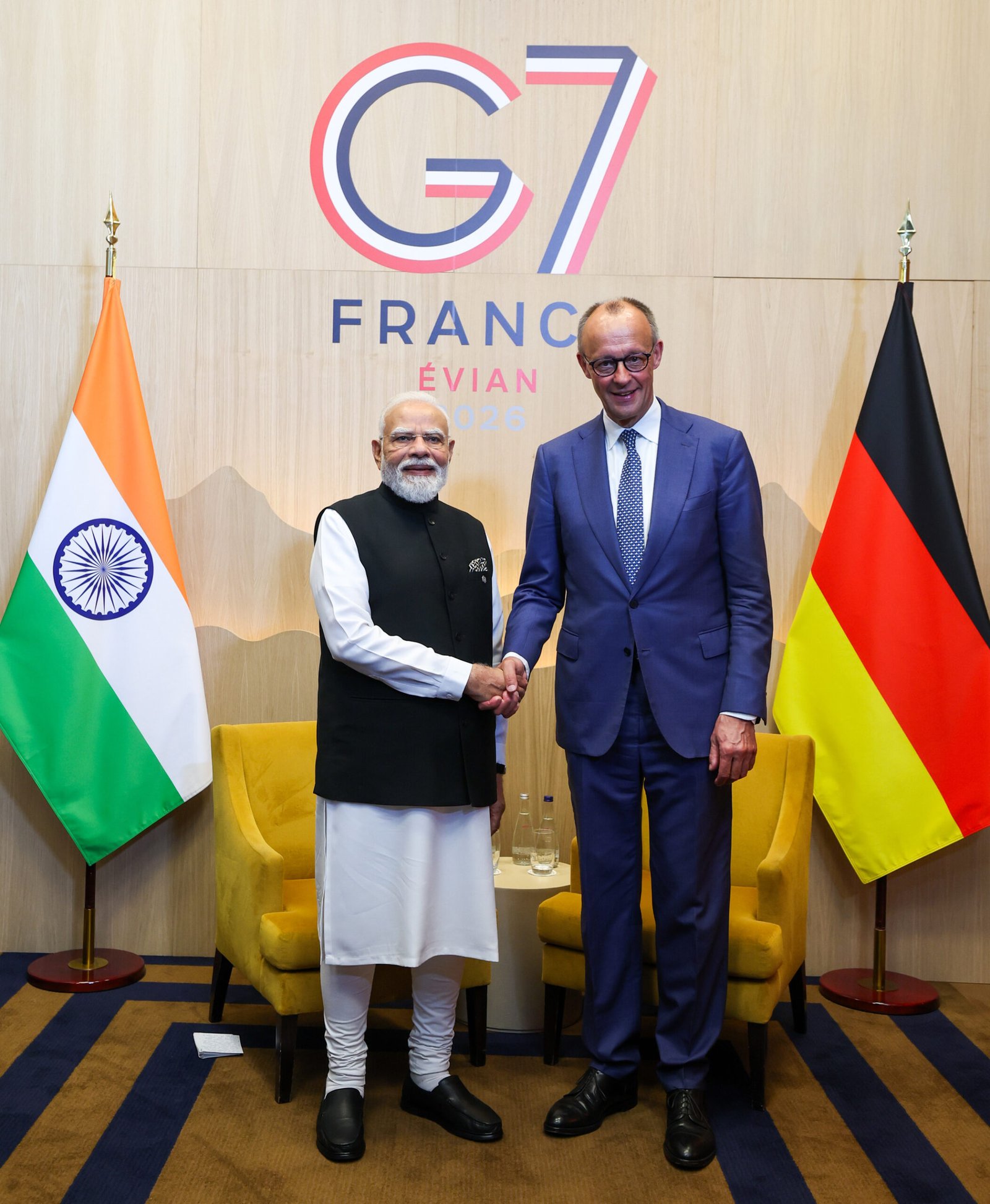
The call comes in a year when India and Germany are marking 75 years of diplomatic relations. Modi and Merz had last met on the margins of the G7 summit in Évian, France, on 17 June 2026, where their talks focused on shoring up bilateral cooperation in trade, investments and defence.
Germany is among the most influential voices inside the European Union, and Berlin’s backing carries weight as the trade agreement moves through the Council towards signature. For India, the German partnership — spanning trade, defence, technology, education and mobility — has become one of its most consequential relationships in Europe.
What Happens Next
Attention now turns to December, when the signing is expected to take place. The precise date and venue will be watched closely in both New Delhi and Brussels, as will the subsequent scrutiny in the European Parliament, which can only accept or reject the agreement and cannot reopen negotiations.
If the timetable holds — signature in December, parliamentary consent in the spring, and entry into force by the middle of 2027 — the deal would begin reshaping trade between two of the world’s largest economies within months. Tuesday’s call between Modi and Merz was, in that sense, as much about the weeks ahead as about the state of the bilateral relationship today.
डिस्क्लेमर: यह खबर उपलब्ध स्रोतों और सत्यापन के आधार पर तैयार की गई है। किसी तथ्य में त्रुटि होने पर सुधार प्रकाशित किया जाएगा।