







New Delhi Bureau
Summary: Delhi flight delays Diwali smog — nearly half of all flights leaving Delhi’s Indira Gandhi International Airport were delayed in the hours after Diwali, as thick smog and shallow fog cut visibility and forced the airport to switch on the first low-visibility procedure of the winter season. The disruption eased on Tuesday but did not end, with close to 200 flights still delayed by midday, even as the capital’s air quality stayed in the very poor category.
Delhi flight delays Diwali smog: departures hit hardest, arrivals largely on time
Delhi flight delays Diwali smog hit departing passengers far harder than arriving ones. Between midnight on November 8 and 8 pm on November 9, around 44 per cent of departing flights from the capital’s airport were delayed, with the average delay standing at approximately 20 minutes. Arriving flights, by contrast, operated with little or no delay during the same period.
The impact was visible on Diwali night itself, when Delhi Airport activated its first Low Visibility Procedure (LVP) of the 2026-27 winter season. The procedure is a precautionary safety measure used when smog and shallow fog reduce visibility around the runways. The airport issued a passenger advisory on the low-visibility procedures, while making it clear that flight operations were continuing and had not been suspended.
Delhi’s airport is among the busiest in the country, handling well over a thousand flight movements on a normal day, so even a partial disruption quickly affects tens of thousands of travellers. The Diwali-night delays came at the end of a long festive weekend, when many passengers were returning to the capital or flying out for the holidays, adding to the crowding at terminals.
Tuesday’s picture: disruption eases but does not end
By Tuesday, the disruption picture remained mixed. An examination of flight-tracking data for Delhi, accessed at around 12.45 pm on November 10, showed an average delay of 13 minutes. The tracker listed 197 delayed flights, accounting for approximately 14 per cent of its reported daily flight movements, and 32 cancellations, or around 2 per cent. The tracker showed 719 departures and 704 arrivals scheduled or recorded for the day at the time of the snapshot.
These figures represent the airport’s reported operational position at the time of checking, rather than a final end-of-day count. They also do not establish that all the delays or cancellations were caused by poor visibility, since flight schedules can slip for operational reasons too. But the weather picture on Tuesday morning left little doubt about the conditions pilots were facing.
Historical airport weather observations showed visibility of around 2,000 metres during the early morning hours, before it dropped to approximately 600 metres at 6.30 am and remained at that level at 7.30 am. The corresponding observations described the conditions as shallow fog. By the afternoon, flight-tracking data was reporting clear conditions at the airport, with the average delay holding at 13 minutes. The 600-metre reading is a meteorological visibility observation, not a runway-specific runway visual range measurement, which is the figure that matters most for individual landings and take-offs.
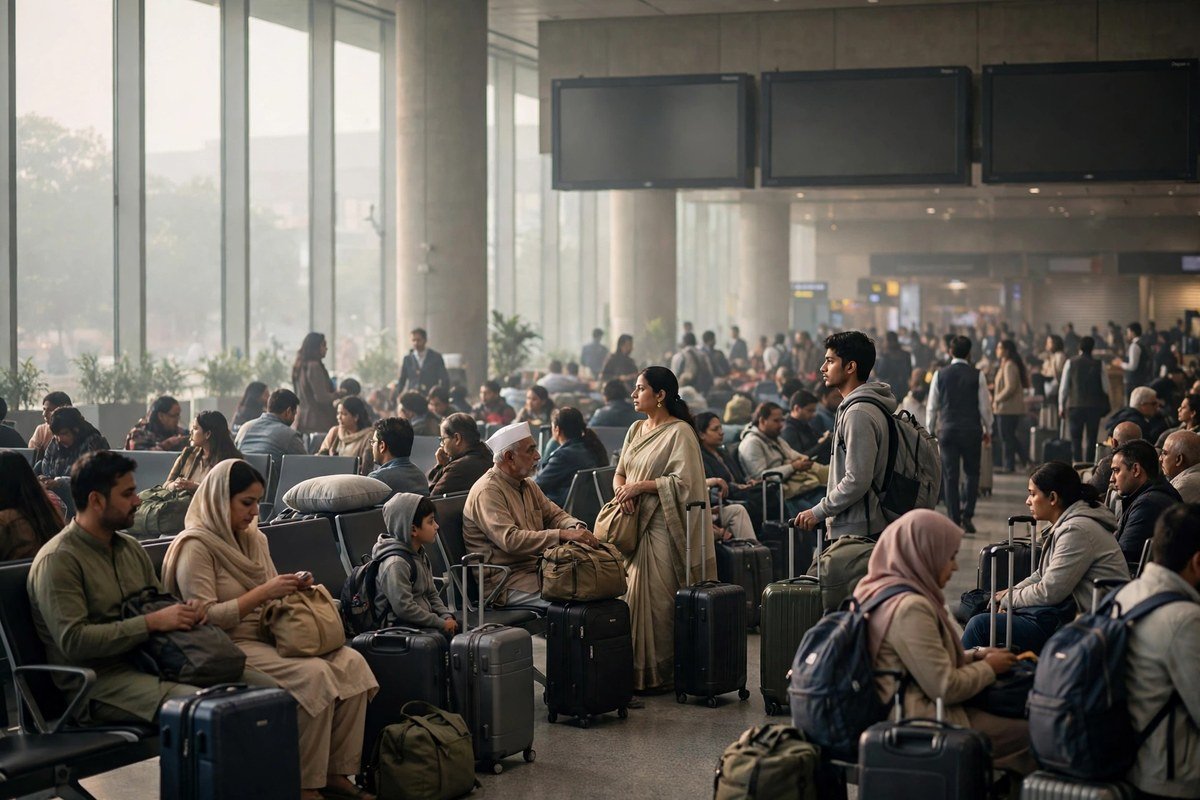
The morning before had been worse. On Monday, visibility at Safdarjung fell to 50 metres at 6.30 am, placing it in the dense fog category, while Palam recorded 400 metres. By 9 am on Monday, visibility had improved to 500 metres at Safdarjung and 900 metres at Palam, with both stations reporting shallow fog. The two mornings together show how the smog-fog combination lingered over the capital for a full day after the festival.
Why CAT-III runways do not guarantee on-time flights
Delhi’s airport has runways equipped for Category III (CAT-III) operations, which allow aircraft to land in very low visibility. But the technology does not offer an unconditional guarantee against delays. Whether a flight can land or take off in poor visibility depends on several factors, including runway visual range, the equipment fitted on the aircraft, the airline’s authorisation for low-visibility operations and the qualifications of the pilots operating the flight.
That is why a low-visibility procedure can be in force while most flights still operate, and why some flights are delayed or cancelled even when the airport itself stays open. Airlines also have to manage crew duty hours, aircraft rotation and connecting passengers, so a delay early in the day can cascade through the schedule. The airport’s advisory put it plainly: low-visibility procedures were in progress, all flight operations were presently normal, and passengers should contact the airline concerned for updated flight information.
For passengers, the practical advice remains the same through the fog season: check the flight status before leaving for the airport, keep the airline’s helpline and app handy, and allow extra time for the journey to the airport, since road traffic also slows in poor visibility.
Delhi AQI remains very poor after the most polluted Diwali in five years
Delhi flight delays Diwali smog came against the backdrop of a sharp deterioration in the capital’s air quality after the festival. According to official air-quality data, Delhi recorded an average AQI of 376 on Diwali, its highest Diwali-day reading since 2021, making it the most polluted Diwali in five years. The pollution level remained high the following morning, with the city’s AQI reaching 371 by 10 am on November 9, the highest post-Diwali reading since 2021.
On Tuesday, November 10, there was some improvement. Official readings placed Delhi’s overall AQI at around 304 at 7.15 am, keeping the city in the very poor category. Pusa and Chandni Chowk recorded readings of 395 each, while NSUT Jaffarpur registered 382 and the Commonwealth Sports Complex 380. The Delhi government’s air-quality portal recorded an overall reading of 307 at the same time. PM2.5 remained the dominant pollutant across most of Delhi’s monitoring stations.
The capital’s air had already turned hazardous before Diwali — the air had already turned hazardous before Diwali, with the AQI touching 369 in the days leading up to the festival. Monitoring data also showed PM2.5 readings crossing 900 at several stations on Diwali night, including nearly 1,000 at the airport’s own monitoring station in the early hours, before some stations stopped reporting. Across the region, 1,248 crop-residue burning incidents were recorded on Diwali, compared with 135 a year earlier, adding to the load from vehicles, dust and festive fireworks.
Later on Tuesday, the air improved further to the poor category, with the average AQI settling at 299 as wind speed picked up. The improvement, however, did not lift the city out of the unhealthy range, and five stations were still reporting very poor air. The Air Quality Early Warning System has forecast that air quality will remain in the very poor category on November 10 and 11 because of unfavourable meteorological conditions.
GRAP Stage III curbs stay in force as the capital waits for wind
Stage III restrictions under the Graded Response Action Plan (GRAP) remain in force following the Commission for Air Quality Management’s decision. The emergency action plan applies across Delhi and adjoining districts of Haryana, Uttar Pradesh and Rajasthan. GRAP is a four-stage emergency framework managed by the air-quality commission in coordination with the pollution control board and regional state governments, and Stage III brings additional pollution-control measures and increased enforcement alongside the restrictions already in place.
The weather department has forecast moderate fog during the day, with the maximum temperature likely to settle at 28 degrees Celsius and the minimum at 15 degrees. Moderate fog is expected over the coming days, and Delhi is unlikely to receive rainfall until November 15, with an approaching western disturbance expected to affect the western Himalayan region without bringing rain to the capital. The identified winter fog period for 2026-27 runs from December 15 to February 15, which means the present episode is occurring ahead of the main winter fog season — and the low-visibility procedures seen this week may have to be repeated several times before the season ends.
What next: a long fog season lies ahead
For Delhi’s airport and its passengers, the Diwali disruption is a preview of the months ahead. The first low-visibility procedure of the season has already been used, the air remains very poor, and the forecast points to more foggy mornings with no rain in sight to wash the pollutants out of the air. Airlines, the airport operator and the weather office will be watching runway visual range readings each morning, and passengers flying out of the capital should expect the possibility of delays on the worst mornings.
For the city itself, the question is whether the improvement seen on Tuesday — stronger winds pulling the average AQI down from 376 to 299 — can hold. Until the air clears properly, the combination of smog, shallow fog and low visibility will keep disrupting both flights and daily life in the capital, and the emergency curbs under GRAP Stage III will stay in place.
डिस्क्लेमर: यह खबर उपलब्ध स्रोतों और सत्यापन के आधार पर तैयार की गई है। किसी तथ्य में त्रुटि होने पर सुधार प्रकाशित किया जाएगा।