








New Delhi Bureau
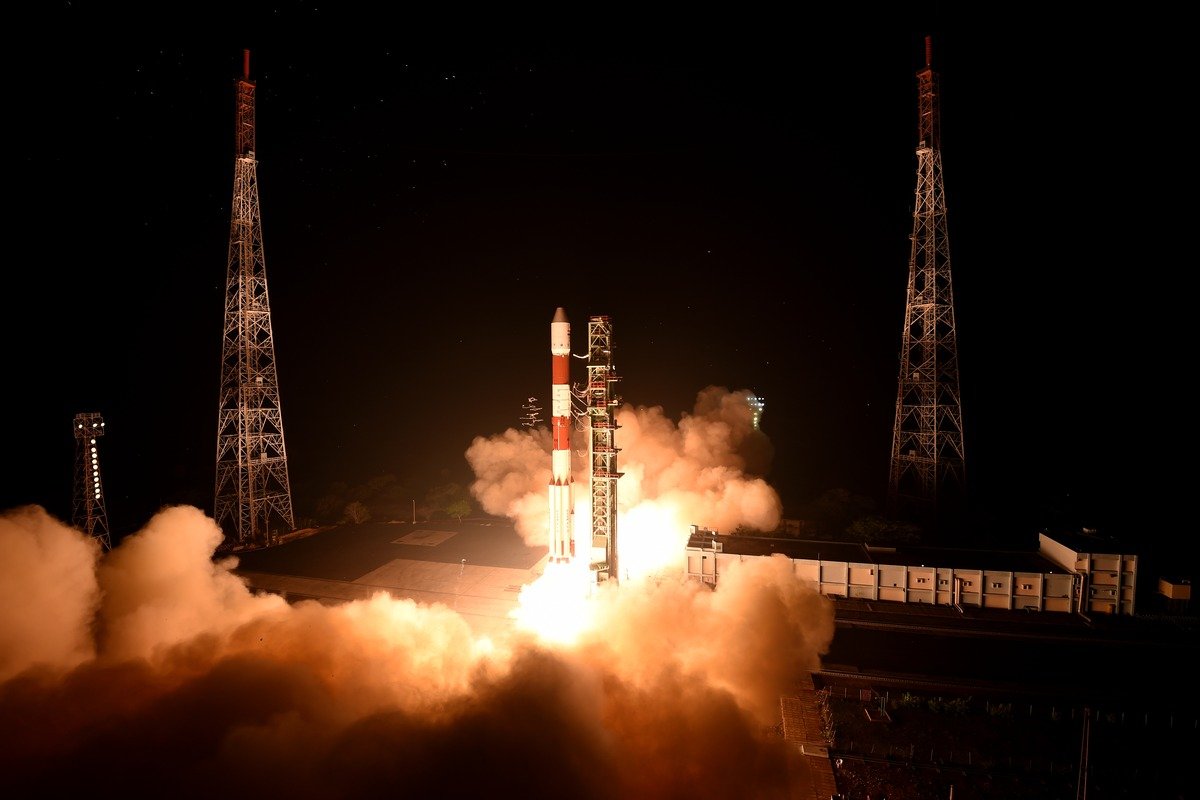
India’s first industry-built PSLV-N1 rocket will lift off in the first quarter of 2027, Indian Space Research Organisation Chairman V Narayanan has announced — a milestone that hands the country’s most trusted launch vehicle to industry for the first time.
The PSLV-N1 launch will be the first time a Polar Satellite Launch Vehicle is built end to end outside the space agency itself. For more than three decades the PSLV has been assembled by the space agency with industry support; now a Hindustan Aeronautics Limited and Larsen & Toubro consortium will manufacture, assemble and integrate the rocket, under a contract awarded by NewSpace India Limited, the agency’s commercial arm.
PSLV-N1 launch: a workhorse rocket, built by industry for the first time
The PSLV-N1 launch is targeted for the first three months of 2027, the ISRO chairman said on Tuesday on the sidelines of the India International Space Conclave in New Delhi. The rocket is getting ready, and the first flight of the industry-built vehicle is expected in the first quarter of next year.
Under the contract signed in September 2022, the HAL–L&T consortium was given five PSLV rockets to build, in a deal worth Rs 860 crore. Unlike earlier arrangements, where private firms supplied parts and subsystems, the consortium has been assigned the end-to-end realisation of PSLV-XL launch vehicles, starting with PSLV-N1. The model is government-owned and contractor-operated: the space agency retains ownership of the PSLV, while the consortium handles manufacturing, assembly and integration.
The schedule has already slipped once. The PSLV-N1 was meant to launch this year, but the deadline was pushed to 2027. The new target — the first quarter of 2027 — is the first firm date the agency has put on the maiden flight.
The PSLV is often called the agency’s workhorse because it has been its most dependable and versatile launch vehicle, particularly for polar and Sun-synchronous orbits. Handing its production to industry is therefore not a small administrative change; it is a test of whether India’s private sector can build, to the same standard, the rocket that has carried the country’s most important missions.
Why India needs many more satellites
The push to build more rockets comes from a blunt admission: India currently operates only 56 space assets. The ISRO chairman said the country needs to build a lot of space assets for communication, navigation and earth observation, and that this cannot be done by the government sector alone.
The scale of the gap was illustrated with a striking example. During Operation Sindoor, 25 satellites had to be deployed in a small sector. If the entire country, from north to south and east to west, has to be protected, the chairman said, imagine the type of space assets and coordinated effort that would be needed.
The demand is not only strategic. For telephone connections with less than 50-millisecond latency and high-speed internet for 140 crore Indians, a large number of satellites are needed. One of the missions in the pipeline is the Earth Observation Satellite EOS-05, India’s first imaging satellite placed in the geo-platform, which will persistently monitor India and nearby areas. The agency is also rebuilding its indigenous regional navigation constellation, NavIC, which had three satellites; a fourth was recently launched to restore the minimum operational configuration.
Also read: GSLV-F18 to carry NVS-03 navigation satellite for NavIC
Gaganyaan in its final phase
On the country’s first human spaceflight programme, the ISRO chairman was emphatic: the Gaganyaan mission is not delayed. Describing it as a highly technology-intensive activity, he said preparations have reached their final phase, with the rocket and other items ready, and work continuing on the orbital module. The mission will be launched at the earliest opportunity, he said.
Reports in recent days had suggested the first uncrewed flight could slip to February 2027, from an earlier target of December 2026. The chairman rejected that characterisation outright. No confirmed launch date for the first uncrewed flight has been announced, and the agency has not set one publicly.
The Vikram chip: building space electronics at home
The announcement also carried an update on semiconductor localisation — one of the quieter but more consequential parts of the space programme. A satellite or a launch vehicle carries a large number of electronic components, such as computer chips and processors, and there was a time when everything was imported.
Together with a semiconductor laboratory in Chandigarh, the space agency has now developed the Vikram processor. The Vikram-16 series is already in use, and the Vikram-32 chip has come out, with 32 chips produced and set to be inducted into the programme. It is a small step in itself, but it points to the same direction as the PSLV decision: critical space hardware built within the country rather than bought from abroad.
From one startup to more than 440
The space sector’s transformation is visible in its startup numbers. From a single startup, the count has grown to more than 440 companies, and the agency is hand-holding private firms alongside the Indian National Space Promotion and Authorisation Centre. The benefits of the government’s space-sector reforms, the chairman said, will become visible over the next five years.
India is also collaborating with 64 countries on space development, and at least 434 satellites for 34 countries have lifted off from Indian soil during the last 12 years. The government is fast-tracking satellite launches in collaboration with startups, precisely because the current fleet of 56 space assets is far short of what the country needs.
How the new model differs from NASA and SpaceX
The Indian model is deliberately different from the best-known private-space arrangement in the world. In the United States, NASA does not own SpaceX’s Falcon 9 rockets; it contracts the company for launch services, including carrying payloads and astronauts, while SpaceX develops, owns and operates its own launch vehicles.
In India, the space agency retains ownership of the PSLV and has handed over the manufacturing, assembly and integration of five proven PSLV-XL rockets to the HAL–L&T consortium. The consortium is essentially tasked with manufacturing rockets that have already established their capabilities through multiple missions — a lower-risk route into private production than designing a new rocket from scratch.
What happens next
All eyes will now be on the first quarter of 2027, when PSLV-N1 is scheduled to make its maiden flight. The payload for that first industry-built rocket, and the exact launch date, are yet to be announced. So is the date of Gaganyaan’s first uncrewed flight, which the agency says is in its final phase.
Also read: Science and technology’s biggest gathering opens in Delhi
What is already clear is the direction of travel. The rocket that has defined India’s space programme for a generation will soon be built by Indian industry, the chips inside it will increasingly be Indian, and the companies around it will increasingly be Indian startups. The PSLV-N1 launch, when it happens, will be the first flight of that new arrangement — and the first real test of whether it works.
डिस्क्लेमर: यह खबर उपलब्ध स्रोतों और सत्यापन के आधार पर तैयार की गई है। किसी तथ्य में त्रुटि होने पर सुधार प्रकाशित किया जाएगा।